

Anxiety looks different for all of us; sometimes it’s relentless worry, sometimes panic, avoidance, or physical tension you can’t shake.
When my symptoms start disrupting daily life activities, I find that knowing who can prescribe anxiety medication becomes essential.
If you are managing distinct anxiety types or exploring options like metoprolol for anxiety, this blog clarifies which providers are authorized to help so you can move forward with confidence.
What is Anxiety Before Seeking Any Medication
Anxiety is a normal human emotion, but when it becomes a disorder, it isn’t just one condition. It’s a group of different anxiety disorders, each with its own triggers, symptoms, and treatment needs.
The American Psychiatric Association recognizes several as separate clinical diagnoses, including generalized anxiety disorder, panic disorder, and social anxiety disorder.
The NIMH reports that anxiety disorders are among the most common mental health conditions in the U.S. Even so, many people never get proper care, often simply because they don’t know where to start.
Who Can Prescribe Anxiety Medication?

Not all mental health professionals have prescribing authority. Knowing who can prescribe anxiety medication helps you seek care from the right provider without delay.
1. Psychiatrists
Psychiatrists are medical doctors specializing in mental health, with 8+ years of rigorous training.
Psychiatrists have the most specialized mental health training of any prescribing provider and are particularly well-suited for:
- Complex or treatment-resistant anxiety
- Cases where multiple mental health conditions coexist
- Situations where medication management and therapy need to be combined
2. Primary Care Physicians (PCPs)
Primary care physicians, family doctors, and internists are often the first stop for anxiety treatment in the U.S. They prescribe 79% of antidepressants and treat 60% of depression cases, with anxiety following similar trends.
PCPs are an accessible and practical option for many people, particularly for:
- First-line treatment of mild to moderate anxiety
- Long-term medication management
- Patients who already have an established relationship with their doctor
3. Nurse Practitioners and Psychiatric Nurse Practitioners
Psychiatric nurse practitioners (PMHNPs) are increasingly filling critical gaps in anxiety care.
Their prescribing authority varies by state, and some states grant full independent practice, while others require physician oversight.
PMHNPs are especially active in community mental health and integrated care settings, expanding access where psychiatric services are scarce.
4. Physician Assistants (PAs)
Physician assistants (PAs) work alongside supervising physicians and play a meaningful role in managing anxiety medications.
Particularly in primary care and integrated behavioral health settings, per a 2024 analysis by Remedy Psychiatry.
They diagnose anxiety disorders, initiate treatment, and coordinate with psychiatric specialists when advanced care is needed.
5. Can Therapists Prescribe Anxiety Medication?
Most therapists cannot prescribe anxiety medication, as licensed counselors, social workers, and psychologists typically focus on psychotherapy rather than medication management.
However, a handful of states allow specially trained psychologists to prescribe under specific conditions.
Elsewhere, therapists work alongside psychiatrists or physicians, coordinating care so clients receive both therapy and medication support when needed.
Building a steady set of coping skills alongside this kind of care often makes the biggest long-term difference.
What are the Distinct Anxiety Disorders?
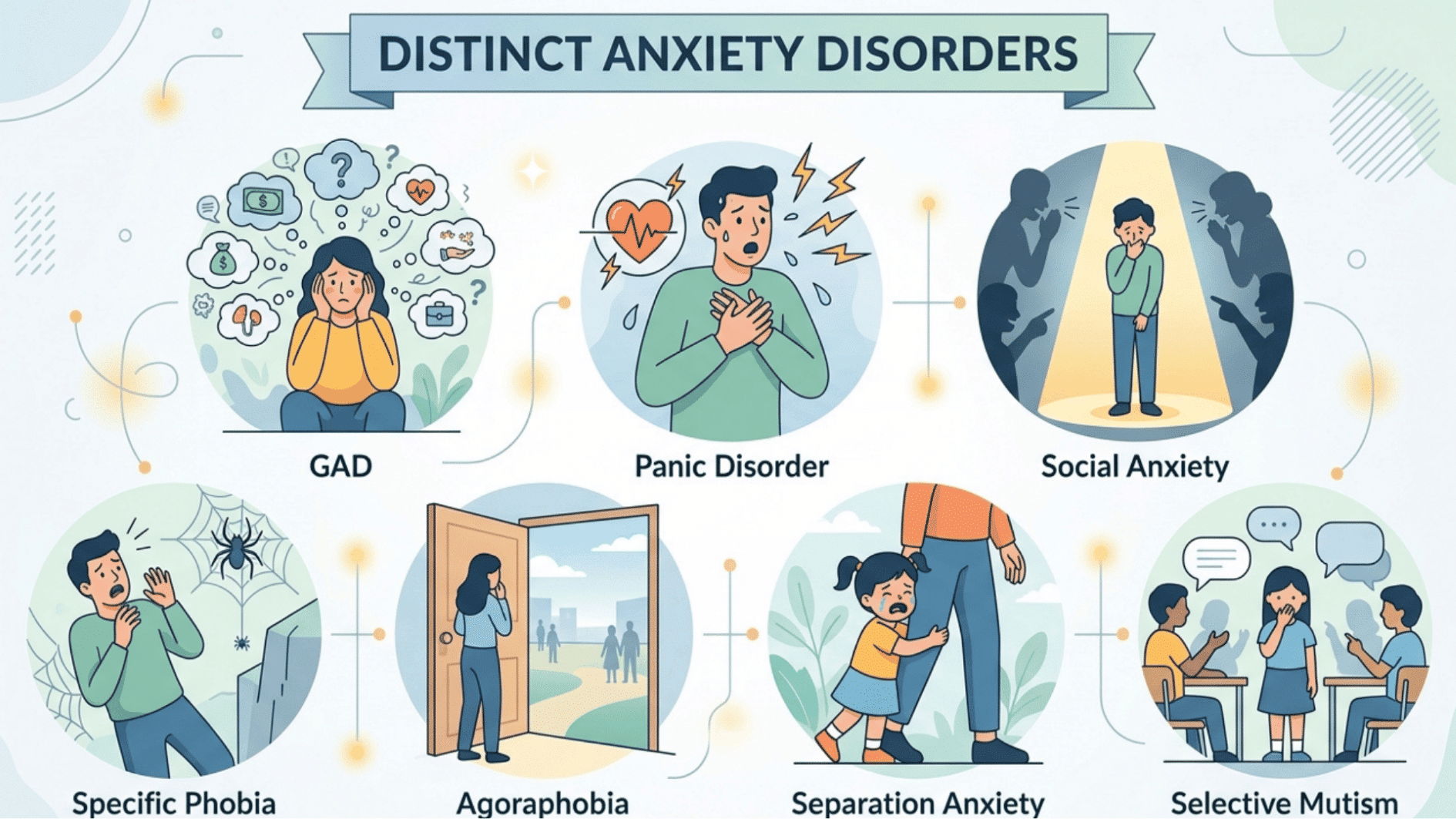
Before discussing prescribing authority, it helps to understand the distinct anxiety conditions that healthcare providers diagnose and treat.
According to the American Psychiatric Association’s DSM-5-TR, anxiety disorders are classified as follows:
|
Anxiety Disorder |
Key Feature |
|
GAD |
Long-term excessive worry about daily life (6+ months) |
|
Panic Disorder |
Sudden, repeated panic attacks with strong physical symptoms |
|
Social Anxiety |
Fear of social situations and being judged |
|
Specific Phobia |
Intense fear of a specific object or situation |
|
Agoraphobia |
Fear of places where escape feels difficult |
|
Separation Anxiety |
Fear of being away from loved ones |
|
Selective Mutism |
Not speaking in certain situations (often in children) |
Note: The NIMH estimates that an estimated 19.1% of U.S. adults experienced any anxiety disorder in the past year, with females (23.4%) more affected than males (14.3%).
What Medications are Commonly Prescribed for Anxiety?
Healthcare providers who are authorized to prescribe anxiety medication may recommend different classes of drugs depending on the type and severity of your condition, as common options include:
|
Treatment Type |
Examples |
Key Use |
|
SSRIs |
Sertraline, Escitalopram |
First-line treatment for anxiety disorders |
|
SNRIs |
Venlafaxine, Duloxetine |
Used for anxiety and related depression |
|
Buspirone |
Buspirone |
For generalized anxiety, non-habit-forming |
|
Benzodiazepines |
Lorazepam, Clonazepam |
Short-term relief; risk of dependence |
|
Beta-blockers |
Propranolol (off-label) |
Controls physical symptoms like rapid heartbeat |
Can Metoprolol Help with Anxiety?

Metoprolol is a beta-1-selective adrenergic blocker primarily approved by the FDA for cardiovascular conditions, including hypertension, angina, and heart failure.
When used in the context of anxiety, metoprolol may help reduce physical symptoms such as rapid heartbeat and trembling – particularly in situations like public speaking by blocking the physical stress response.
Anxiety can also show up as dizziness or lightheadedness, which is one reason providers weigh these physical symptoms carefully before prescribing.
Important Considerations if Metoprolol for Anxiety is Being Discussed:
- It must be prescribed by a licensed healthcare professional
- It is not appropriate for all patients (contraindicated in severe bradycardia, heart block, and decompensated heart failure)
- Side effects can include dizziness, fatigue, and potential bronchospasm
- It does not address the psychological or cognitive dimensions of anxiety
Always speak with your prescribing provider about whether metoprolol for anxiety is clinically appropriate for your specific situation.
Community Opinions on Anxiety Medication
Figuring out where to turn can feel overwhelming when you’re already anxious, and here’s reassuring, real-world guidance from clinicians and health communities on choosing the right provider.
A primary care doctor can start the process.
One person shared that their first anxiety prescription came from a regular primary care physician, not a specialist, and that they only saw a psychiatrist later on. (Quora)
Family doctors have limits worth knowing.
Another user said their first anxiety medication came from an online doctor, not a psychiatrist, but noted that a family doctor’s prescribing options can be more limited than a specialist’s. (Quora)
In the US, primary care is the default.
One answer put it simply: unless someone is already seeing a psychiatrist, a primary care doctor is typically who writes the anti-anxiety prescription. (Quora)
A physician assistant can also prescribe.
One person recalled getting their first anxiety medication from a PA after a personal loss, describing a careful, low-dose approach before the prescription ended. (Quora)
Sometimes the path starts after a hard event.
Another user described seeking a prescription following a traumatic experience, after having previously used a similar medication informally. (Quora)
The Bottom Line
Knowing who can prescribe anxiety medication as psychiatrists, PCPs, NPs, or PAs puts you in control; from SSRIs to metoprolol for anxiety-related physical symptoms, treatment is tailored to your needs.
Since distinct anxiety disorders require distinct approaches.
The most important step is simply starting the conversation with a licensed professional, as proper care exists – and with the right provider, managing anxiety becomes a process, not a guessing game.
Frequently Asked Questions
Can I Start with My Regular Doctor Instead of Going Straight to A Psychiatrist?
Absolutely! Your primary care physician is a great first step, as they manage most anxiety cases and can refer you if needed.
Is It Possible to Manage Anxiety without Medication?
Yes, many people find relief through therapy, lifestyle changes, or a combination – medication is one option, never the only path forward.
Will I Have to Stay on Anxiety Medication Forever Once I Start?
Not necessarily; many people use medication short-term alongside therapy, and your provider will guide the right duration for you.