Bad news lands, and within minutes you reach for something: a call to a friend, a long walk, a glass of wine, or an hour of unplanned scrolling.
The choice rarely gets a second thought, and that’s what’s called a coping mechanism.
But hardly anyone looks up the meaning of a coping mechanism, yet everyone acts it out every day. That small habit express more than it seems, and the reason it keeps winning will surely surprise you.
Read on to find out what’s really going on.
Coping Mechanism Meaning in Psychology
A coping mechanism is any thought or action you use, usually on purpose, to manage stress, painful emotions, or a situation that feels like too much.
In psychology, it covers both sides of stress: handling the problem itself and easing the emotions it stirs up.
|
Study Insight In 1980, Susan Folkman and Richard S. Lazarus of the University of California, Berkeley published a yearlong study in the Journal of Health and Social Behavior. They followed 100 adults aged 45 to 64 through 1,332 stressful events from everyday life. Most people’s coping changed from one situation to the next, and the two biggest drivers were the setting and how each person judged the event. That helps explain why someone can handle stress well one day and struggle the next. |
How Do Coping Mechanisms Work?
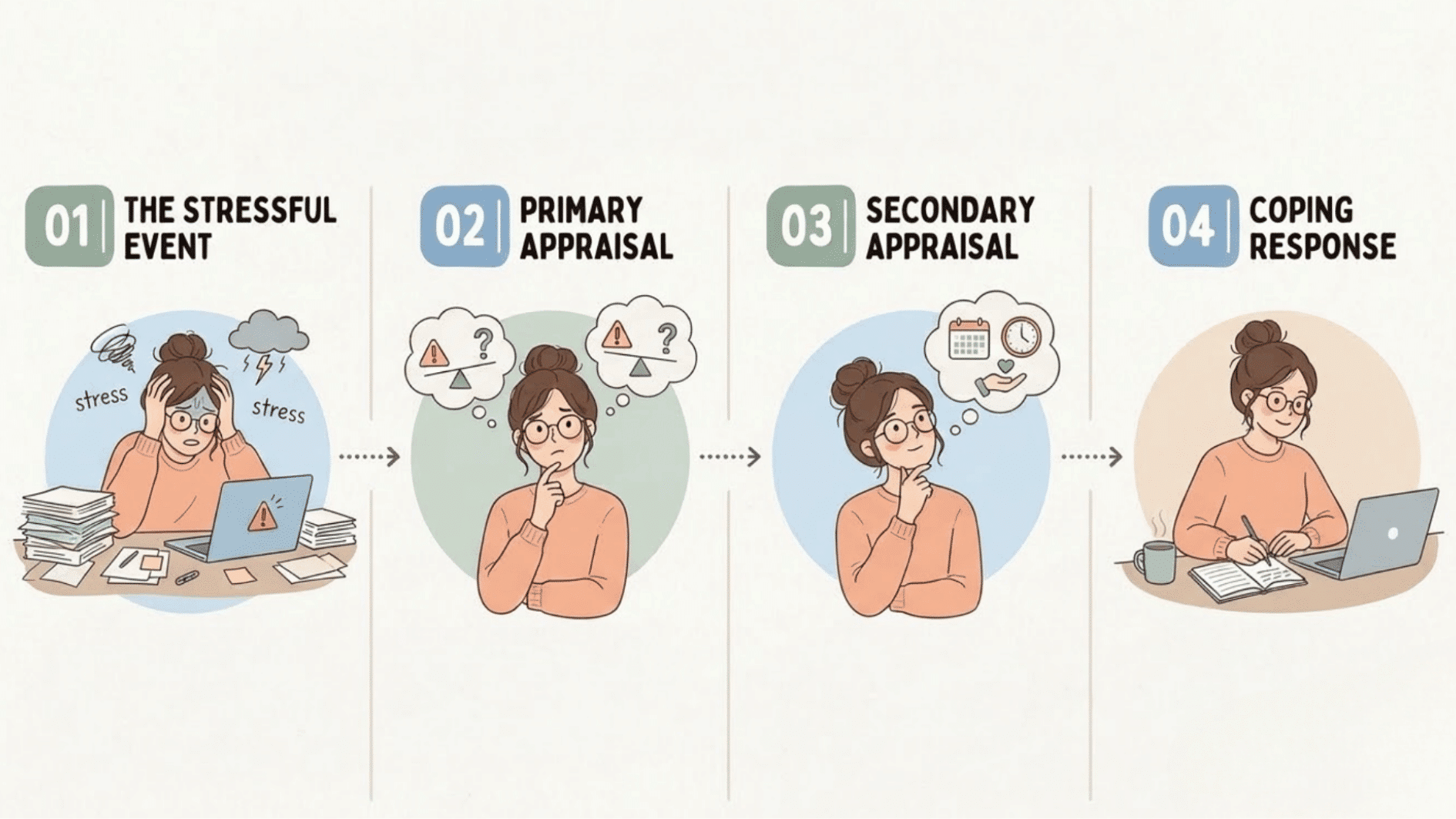
Richard Lazarus and Susan Folkman explained coping through the transactional model of stress and coping. Their big idea is simple: stress depends less on what happens to you and more on how you interpret it.
1. The Stressor
A stressor is any event that asks something of you. It can be big, like losing a job, or small, like a rude email. The word “demand” fits because the event asks for your time, energy, or a decision. On its own, it is only the trigger.
Example: Your manager tells you that you will present to the team tomorrow.
2. Primary Appraisal
This step is called primary because it comes first. Your mind sorts the event into one of the boxes: irrelevant, harmless or positive, or stressful.
If it’s stressful, you see it as harm already done, a threat of future harm, or a challenge you could grow from. A challenge still counts as stress, which is why the same event can feel scary to one person and exciting to another.
Example: You file tomorrow’s presentation under “threat,” because you worry about freezing or performing badly in front of everyone.
3. Secondary Appraisal
“Secondary” means second, but not less important. Here you take stock of what you have: time, skills, money, and people who can help. This step decides how heavy the event feels.
If you believe you have enough to handle it, the stress stays manageable. If you believe you don’t, the same event feels much heavier.
Example: A colleague can review your slides, and you have an evening to practice. The threat now feels smaller.
4. The Coping Response
This step is called a “response,” not a solution, because it may not fully fix anything. You act, then check how it went.
What you decided in secondary appraisal shapes what you do next.
If the problem feels controllable, you are more likely to use problem-focused coping. If it feels out of your hands, you are more likely to use emotion-focused coping.
Afterward, you reassess, and the cycle can start again.
Example: You rehearse your slides, then breathe slowly before you start. If it still feels shaky, you review and try again.
What are the Main Types of Coping Mechanisms?
Coping is sorted by what it targets: the problem, your feelings, the meaning of an event, or other people. Most people mix several, depending on the stressor.
-
Problem-Focused Coping: This goes straight at the source of stress. You might make a plan, manage your time, or gather facts.
-
Emotion-Focused Coping: This coping calms the feelings that stress creates through habits like reframing a problem, journaling, or slow breathing.
-
Meaning-Focused Coping: It draws on your values and goals to find purpose or growth in a hard event you can’t change.
-
Social Coping: This means asking others for advice, comfort, or practical help, like calling a friend or joining a support group.
-
Avoidant Coping: It means staying away from the stressor or the feelings it brings, for example, by putting it off, distracting yourself, or withdrawing from other people.
Need relief in a stressful moment? Explore coping skills for anxious moments.
Healthy vs Unhealthy Coping Mechanism Examples
Healthy (adaptive) coping lowers stress and helps you recover over time. Unhealthy (maladaptive) coping brings quick relief but often makes the problem bigger later.
|
Healthy Coping |
Unhealthy Coping |
Why It Matters |
|---|---|---|
|
Going for a walk or workout |
Drinking alcohol to unwind |
Exercise releases built-up tension. Alcohol only dulls it, and anxiety can come back worse the next day. |
|
Talking to a trusted friend |
Pulling away from everyone |
A friend helps you carry the load. Isolation leaves you carrying it alone. |
|
Making a step-by-step plan |
Putting off the problem |
A plan breaks the problem into small tasks. Delay lets it grow. |
|
Writing in a journal |
Bottling up feelings |
Writing gives feelings somewhere to go. Hiding them lets pressure build. |
|
Practicing slow breathing |
Endless scrolling |
Slow breathing calms your body. Scrolling only pauses the stress for a few minutes. |
Coping Vs Defense Mechanisms: What’s the Difference
The two terms often get used as if they mean the same thing, but they don’t. The main difference is awareness.
Coping is a conscious choice, such as going for a walk or making a plan.
Defense mechanisms work outside your awareness. They are unconscious mental processes that protect you from anxiety.
Sigmund Freud first introduced the concept, and his daughter, Anna Freud, expanded on it in her 1936 book The Ego and the Mechanisms of Defense.
|
A Quick Example You miss a work deadline Defense Mechanism: You brush it off as no big deal and leave your manager’s emails unopened, without noticing why. Your mind is shielding you from worry. This is denial. Coping Mechanism: You notice you are avoiding the emails and reply with a new plan. Now you are choosing your response. |
7 Ways to Build Healthy Coping Habits
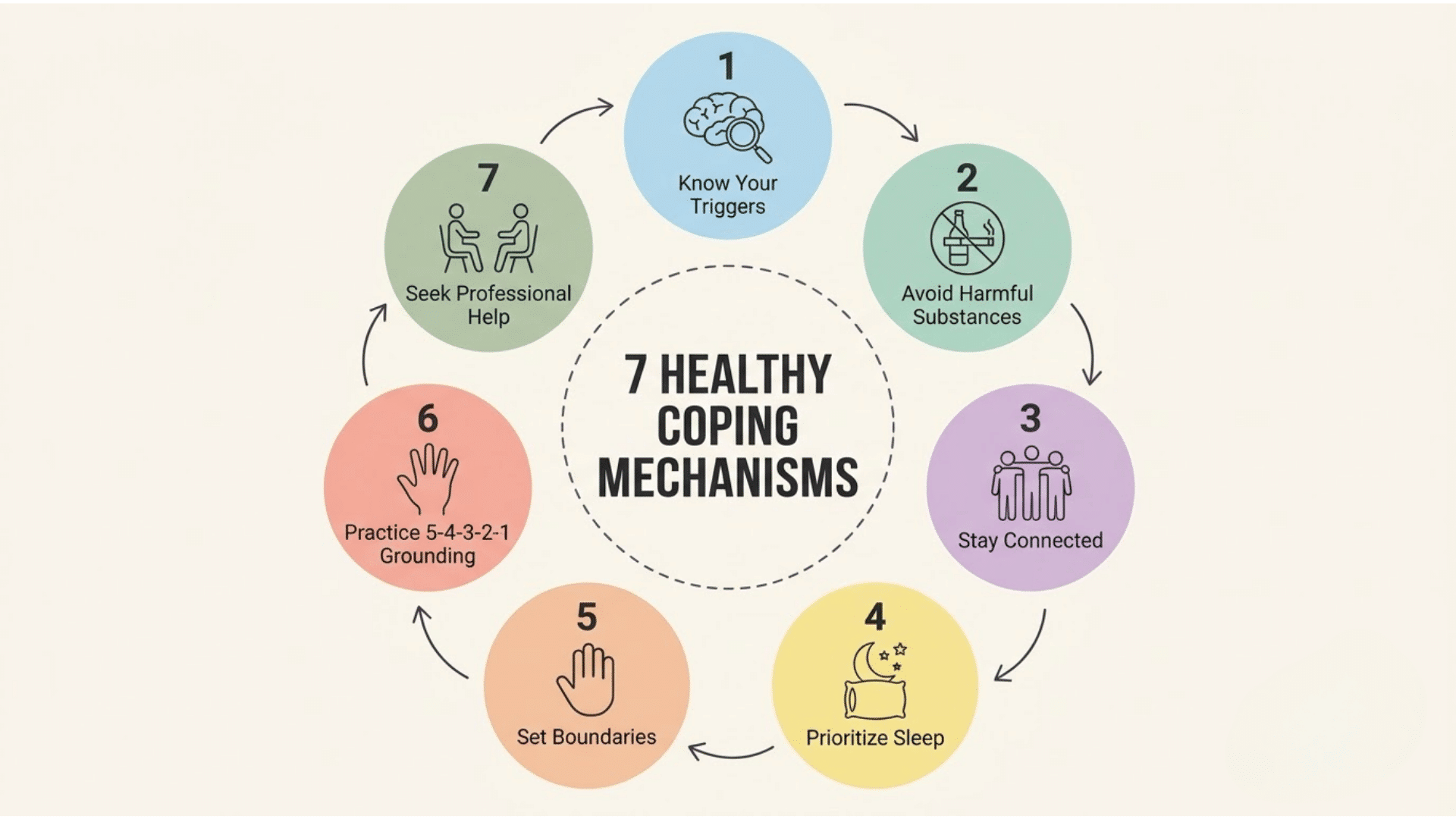
Healthy coping isn’t about avoiding stress completely. It’s about having a few go-to habits that steady you before stress takes over.
-
Identify Your Triggers: Notice what sets off your stress, like certain people, places, or times of day. Knowing your triggers helps you prepare.
-
Avoid Harmful Substances: Too much caffeine or nicotine can feel steadying at first, but both can disturb sleep and raise anxiety later. Alcohol does the same.
-
Keep Your Support System Active: Stay in touch with friends and family on good days too. Regular contact makes asking for help feel easier later.
-
Protect Your Sleep: Most adults need seven or more hours of sleep. A steady bedtime helps you handle stress more calmly.
-
Set Clear Boundaries:Saying no to extra tasks protects your time and energy, and setting boundaries step by step makes that easier. Clear limits stop small pressures from piling into burnout.
-
Try the 5-4-3-2-1 Grounding Method: When stress spikes, name five things you see, four you touch, three you hear, two you smell, one you taste.
-
Get Professional Support: If stress lasts for weeks or affects daily life, a therapist can teach proven methods like cognitive behavioral therapy.
Conclusion
Every coping mechanism follows the same path: something stressful happens, the mind sizes it up, and a habit steps in.
Some habits tackle the problem, calm your feelings, find meaning, or bring in people you trust, and others only push stress down the road.
Knowing which is which turns an automatic reach into a real choice.
Pick one habit from this guide and start with small, steady changes.
Frequently Asked Questions
Is Crying a Coping Mechanism?
Yes. Crying is an emotion-focused way to release tension, and it often signals to others that you need comfort.
Is Humor a Healthy Coping Mechanism?
Yes, in moderation. Humor eases tension and connects people, but it becomes unhealthy when it replaces facing real feelings.
Can You Learn New Coping Mechanisms?
Yes. Coping is a skill, so new habits can replace old ones with steady practice and, sometimes, a therapist’s guidance.
How Do Children Develop Coping Mechanisms?
Most children learn coping by watching their parents and caregivers, and those early patterns often carry into adulthood.