

If you’re living with depression, you may not realize what financial or legal support could be available to you, and that’s completely okay.
Depression is a clinically recognized condition that can deeply affect your ability to work and function each day.
Many people also ask, Can I get disability for depression?, the Social Security Administration has formal criteria that determine if a mental health condition may qualify for federal disability benefits.
Here, you’ll be gently walked through what that process involves.
Disclaimer: This blog is for informational purposes only and does not constitute legal or medical advice. For guidance specific to your situation, consult a licensed professional.
Can I Get Disability for Depression?
Yes, you can get disability for depression if your condition is severe enoughand the SSA requires documented medical evidence that depression substantially limits a person’s ability to function in a work setting.
The Social Security Administration (SSA) recognizes depression as a condition that may be considered for federal disability benefits under Listing 12.04 of its Blue Book, but eligibility is determined on a case-by-case basis.
There are two federal programs, SSDI and SSI, each with separate eligibility requirements; understanding the distinction is an essential first step.
Depression and Disability Recognition
Clinical depression, formally known as Major Depressive Disorder (MDD), is far more than persistent sadness. It is a recognized medical condition that affects a person’s capacity to think, work, and function in daily life.
Under both the Americans with Disabilities Act(ADA) and the Social Security framework, depression may be recognized as a disability when it substantially limits one or more major life activities.
Working through what qualifies as a disabling mental health condition is often the first thing people search for before they even start the SSA paperwork.
As a threshold, the SSA evaluates through documented medical and functional evidence, as not all depressive conditions are evaluated the same way.
Types of Depression
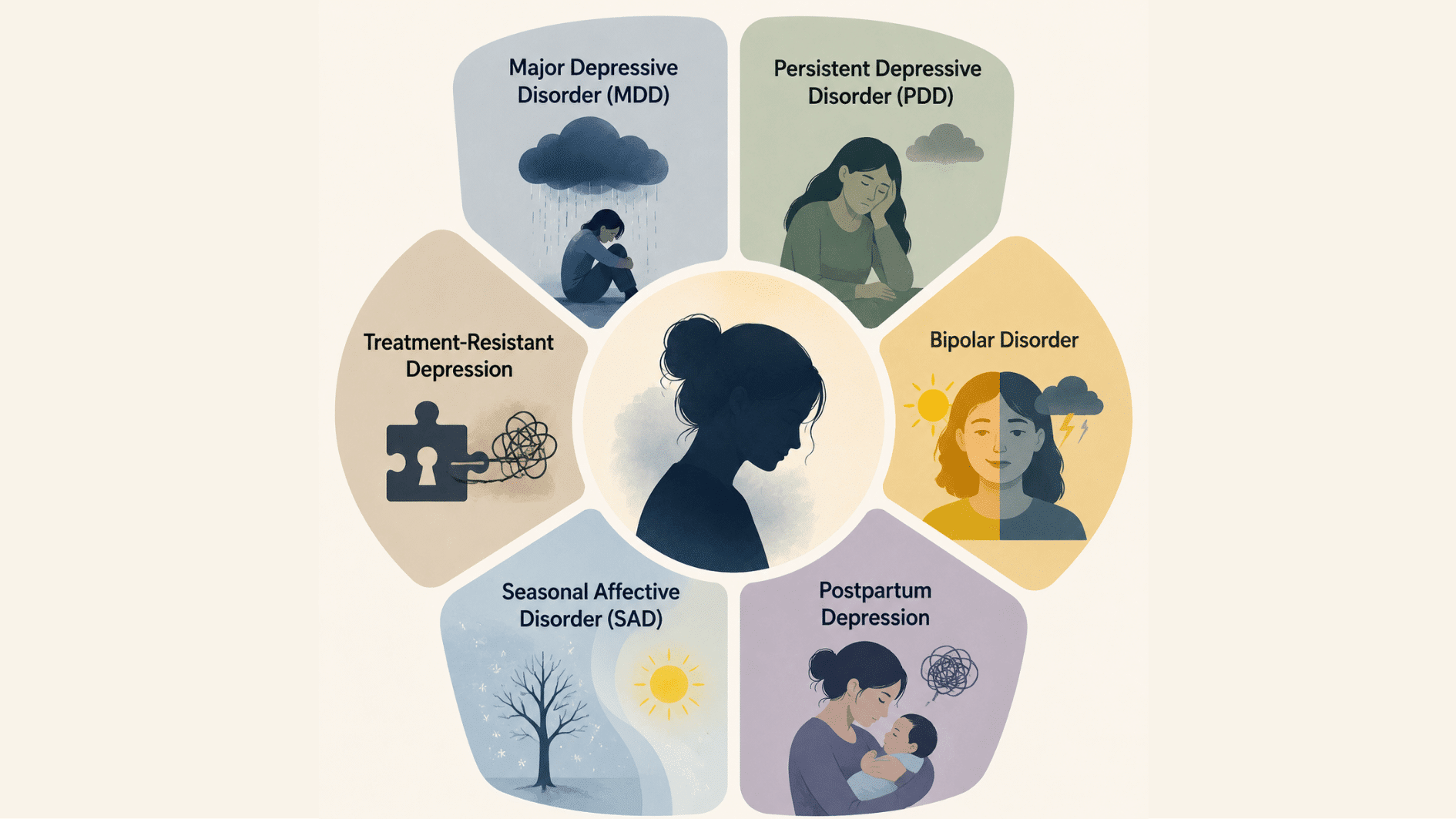
The National Institute of Mental Health (NIMH) and the DSM-5 identify several distinct types of depression, each with different patterns, durations, and triggers.
| Depression Type | Clinical Features | Duration |
|---|---|---|
| Major Depressive Disorder (MDD) | The most common clinical depression | 2+ weeks |
| Persistent Depressive Disorder (PDD) | Chronic, long-term symptoms | 2+ years |
| Bipolar Disorder | Severe depressive phases | Episodic |
| Postpartum Depression | Symptoms after childbirth | Weeks to months |
| Seasonal Affective Disorder (SAD) | Pattern-based depression | Seasonal recurrence |
| Reactive Depression | Triggered by a specific stressful event or loss | Weeks to months, tied to the triggering event |
| Treatment-Resistant Depression | Persists despite treatment | Often years |
For an SSA disability claim, your diagnosis must be formally documented by a licensed mental health professional.
SSDI for Depression: Who Qualifies and How it Works
Social Security Disability Insurance (SSDI) is a federal benefit program for individuals with a qualifying disability who have a work history.
For those asking if they can get disability for depression through SSDI, eligibility requires meeting both a medical threshold and a work-credit requirement.
SSA Listing 12.04
Eligibility requires satisfying Part A (documented symptoms) and either Section B or Section C of Listing 12.04.
Part A: Symptoms
Part A focuses on medical proof of depression symptoms, and to qualify, records must show at least five of nine symptoms, such as:
- depressed mood
- sleep issues
- low energy,
- poor concentration,
- appetite changes,
- guilt,
- anhedonia,
- psychomotor changes,
- suicidal thoughts.
Section B: Functional Limits
It looks at how depression affects daily functioning.
A person must have an extreme limitation in one area or marked limitations in two, including understanding information, interacting with others, maintaining focus, or adapting to stress, change, and self-care needs.
Section C: Persistent Disorder
It applies to long-term or treatment-resistant depression.
The disorder must last at least two years, require ongoing treatment, and leave the person with minimal ability to adapt to new demands, even if symptoms improve somewhat with care.
Work Credit Requirement
SSDI also requires enough earned work credits, as most applicants need 40 credits, with 20 earned in the last 10 years ,roughly five years of full-time work.
As of 2026, every $1,890 in wages earns one work credit (up to four per year, or $7,560 total). If depression created gaps in your employment history, SSI may be the better-fitting program.
SSI for Depression: When Work History is Limited
Supplemental Security Income (SSI) does not require work credits, as it is need-based and designed for people whose limited income or fragmented employment history would otherwise leave them without support.
If depression made sustained work impossible, SSI may be the available path.
|
Feature |
SSDI |
SSI |
|
Based on |
Work history & earned credits |
Financial need – income & assets |
|
Work credits needed |
Yes, typically 40 credits |
No work history required |
|
Income limit |
Cannot earn above $1,690/mo (SGA) |
Limited income; varies by state |
|
Asset limit |
No strict asset limit |
Under $2,000 in countable resources |
|
Federal benefit rate (2026) |
Based on earnings history |
$994/mo individual · $1,491/mo couple |
Can you receive both?- Yes, concurrent benefits are possible.
“SSI does not depend on work history, but as long as you meet the financial criteria which involve resources and income, you can be approved.” – NAMI Iowa
Can You Get on Disability for Anxiety?

You may get on disability for anxiety under SSA Listing 12.06 for Anxiety and Obsessive-Compulsive Disorders.
The criteria closely mirror Listing 12.04 – documented symptoms, functional limitations, and a condition lasting at least 12 months.
This matters because anxiety disorders that don’t fit a single clear category still need the same level of documentation to be taken seriously by the SSA.
In clinical practice, depression and anxiety co-occur frequently, as the SSA is required by federal regulation to evaluate all conditions together.
If you live with both, that combined documentation may actually strengthen your claim.
Applying for SSA Disability Benefits
The SSA reviews every claim through a five-step sequential evaluation. Understanding it before you apply helps you prepare the right evidence from the start and avoid preventable denials.
Step 1: Confirm You Are Not Engaged in Substantial Work
The SSA first checks if you are currently working.
If your earnings exceed $1,690/mo (2026 Substantial Gainful Activity limit), your claim is denied at this step without further review. (SSA Red Book, 2026)
Step 2: Establish That Your Condition Is Severe
Your depression must significantly limit basic work activities such as concentrating, following instructions, or managing stress and must be expected to last at least 12 continuous months.
Medical records from a licensed provider are required to substantiate this.
Step 3: Meet SSA Listing 12.04
This is the most critical step, as the SSA compares your documented symptoms and functional limitations against Listing 12.04, which requires Part A symptoms and either Section B or Section C criteria (detailed in the criteria card above).
Thorough, specific medical documentation is essential here.
Step 4: Demonstrate You Cannot Return to Past Work
The SSA assesses your Residual Functional Capacity (RFC), which is what you are still able to do despite your depression.
If your RFC indicates you could have performed a previous job, benefits may be denied, and a detailedMental RFC formcompleted by your treating physician is one of the strongest pieces of evidence you can provide.
Step 5: Show You Cannot Adjust to Any Other Work
If past work is ruled out, the SSA evaluates if, given your age, education, and transferable skills, any other type of work is feasible.
If no suitable work can be identified, benefits may be awarded.
To Apply: Visit ssa.gov/applyfordisability, call 1-800-772-1213, or go to a local SSA office, and SSDI can be completed online; SSI requires an in-person or phone interview.
What Strengthens Your Claim
Yes, you can get disability for depression and anxiety if it severely limits your ability to work. The SSA carefully evaluates your medical evidence under specific mental health listings.
- Consistent, documented care with a psychiatrist or licensed therapist
- A detailed Mental RFC form completed by your treating physician
- Records of medications tried, their effects, and side effects
- Evidence of hospitalizations or crisis interventions
- Third-party statements from family members or former employers describing your limitations
- Co-occurring conditions: anxiety, PTSD, chronic pain, and documented alongside depression
Consistent care doesn’t only mean medication; the range of interventions a treatment team might use therapy, case management, crisis support, all count as documented evidence toward your claim.
When a Claim is Denied and What Comes Next
A denial is not the end. Around 80% of initial claims are denied, often for reasons that can be addressed (SSA Appeals Process), and understanding the most common ones may help you build a stronger case.
|
Common Reasons for Denial |
How It Affects Eligibility |
|
Limited Medical Evidence |
Records do not clearly show symptom severity or limitations |
|
Treatment Gaps |
Inconsistent care may weaken the claim |
|
Income Above SGA Limit |
Earnings exceed SSA work-income threshold |
|
Incomplete Application |
Missing medical, work, or supporting information |
If denied, file a Request for Reconsideration within 60 days, and if needed, request a hearing before an Administrative Law Judge, where nearly half of applicants are approved.
Most disability attorneys work on a contingency basis; fees are capped by law at 25% of retroactive benefits, up to $6,000. (National Alliance on Mental Illness)
The Bottom Line
Filing for disability benefits while managing depression is not easy – but it is possible if your condition prevents you from working; understanding if you can get disability for depression is the first step toward financial stability.
Document everything, stay consistent with treatment, and if anxiety compounds your depression, know that you can get on disability for anxiety as a co-occurring condition, potentially strengthening your overall claim.
A denial is not the end, and the SSA Appeals Process exists for exactly this reason.
You deserve support, including consulting a licensed disability attorney, working closely with your treating provider, and taking the process one step at a time.
Frequently Asked Questions
How Long Does an Anxiety Disability Claim Usually Take to Process?
Processing times vary based on case details, evidence provided, and if appeals are needed.
Can Anxiety Affect Eligibility for Workplace Accommodations and Protections?
Yes, anxiety may qualify for workplace protections when it substantially limits major life activities.
What Happens if Anxiety Symptoms Improve After Filing a Disability Claim?
The SSA may review changes in your condition to determine continued eligibility for benefits.