

Worry often begins as a single thought but can quickly grow into a mental loop that feels impossible to switch off.
It tends to appear before important events, during periods of uncertainty, or late at night when there are fewer distractions competing for attention.
While worry can feel overwhelming, it is not random. It is a learned mental process the brain uses to anticipate potential problems and prepare for uncertainty.
In this blog, I’ll explain how to stop worrying, why it can become overwhelming, and the strategies that can help.
Defining Worry and How it Affects Us
Worry is a cognitive process involving repetitive thoughts about possible future problems.
According to the Association for Behavioral and Cognitive Therapies (ABCT), worry is typically future-focused and driven by “what if” thinking.
Unlike productive problem-solving, worry rarely leads to action. Instead, it cycles through possibilities without reaching a conclusion.
Many people mistake worry for preparation because it feels mentally active. However, spending hours thinking about a problem is not the same as taking steps to solve it.
Understanding what principle underlies CBT helps explain why this distinction matters. Cognitive approaches focus on catching these unproductive loops before they take hold
How to Stop Worrying: The Best Strategies

When you are unsure what to do when you worry too much, structured techniques like the ones below can help interrupt the cycle.
Many overlap with general coping skills for anxiety, since worry and anxiety often respond to the same tools.
1. Scheduled Worry Time
Set a daily 15- to 30-minute window specifically for worrying. Outside this window, postpone the worry rather than engaging it.
After two weeks of practice, many worries may feel less urgent by the time the scheduled worry window arrives. The American Psychological Association describes this as part of structured cognitive behavioral approaches.
2. Cognitive Defusion
This technique, drawn from Acceptance and Commitment Therapy, helps create distance from thoughts rather than engaging with them directly. Instead of “I will fail,” you shift to “I notice I am having the thought that I will fail.”
It sounds small, but it changes the relationship with the thought entirely.
It sounds small, but it changes the relationship with the thought entirely, a shift that’s central to how to change your mindset around anxious thinking more broadly.
3. Tolerance for Uncertainty
Gradually practice allowing small uncertainties without seeking reassurance. This helps retrain the brain’s response to unknown outcomes over time.
The constant need for reassurance shows up in other contexts too; it’s part of what makes relationship OCD so exhausting, where doubt is chased rather than tolerated.
Starting small matters, even leaving a minor decision unresolved for a day, is a useful practice.
4. Breathing Regulation
Slow breathing at 5 to 6 breaths per minute helps calm the nervous system and shift the body out of a state of stress. A 2017 study in Frontiers in Psychology found this significantly reduced self-reported anxiety.
The National Center for Complementary and Integrative Health(NCCIH) also lists paced breathing as an evidence-informed stress management tool.
5. Write Your Thoughts Down
Journaling can help reduce mental clutter. Instead of carrying worries in your head, put them on paper. This often makes concerns feel more manageable and easier to evaluate objectively.
6. Challenge Your Predictions
Worry often convinces you that the worst-case scenario is the most likely outcome. Before accepting that prediction, ask yourself what evidence supports it and what evidence points to other possibilities.
Many worries never happen as imagined. Regularly testing anxious predictions against reality can help reduce catastrophic thinking over time.
Worry vs Anxiety: Know the Difference
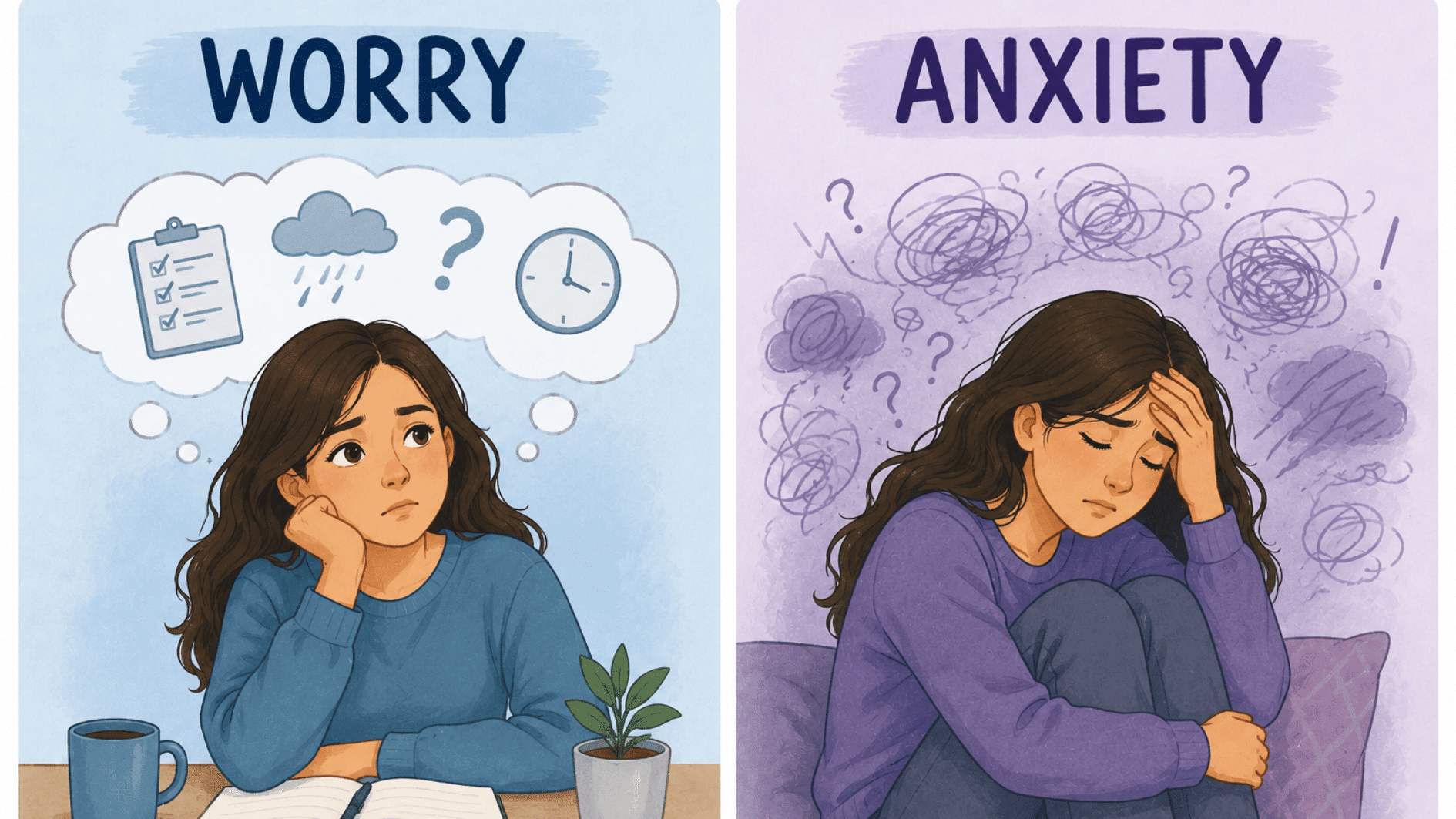
Worry and anxiety are often used interchangeably, but they’re not the same thing. Worry is the mental aspect, while anxiety is the broader emotional and physical aspect.
| Aspect | Worry | Anxiety |
|---|---|---|
| What it is | Thoughts about possible future problems | A mental and physical response to a perceived threat |
| Main focus | Specific situation or concern | General or ongoing sense of fear or unease |
| Duration | Usually temporary | Can persist even without a clear cause |
| Physical symptoms | Few or mild | Racing heart, sweating, muscle tension, restlessness |
| Thought pattern | Repetitive “what if” thinking | Constant fear, dread, or feeling on edge |
| Impact on daily life | May be manageable | Can interfere with work, relationships, or daily activities |
| When it improves | Often eases after the issue is resolved | May continue even after the situation has passed |
At its most intense, anxiety can escalate into a panic attack; some people even wonder whether it’s possible to pass out from one, which shows how physical the experience can become.
According to the APA, anxiety disorders affect approximately 40 million adults in the U.S. each year, making them the most common mental health condition in the country.
Real-Life Examples of Managing Worry
The examples below are based on personal stories shared in online communities and show how some people have worked through persistent worry using practical strategies.
|
Recognizing That Worry Was Ruining Daily Life A user in the r/selfimprovement community shared that they realized their worry had stopped feeling like caution and started feeling like a constant weight. They described how naming the pattern rather than fighting the thoughts was the first thing that actually gave them some relief. |
|
Small Methods That Made a Real Difference Several users in the r/AskReddit thread shared personal techniques for stopping worry in the moment. Common responses included writing thoughts down before bed, setting a timer for worry, and reminding themselves that most feared outcomes never happened. The thread shows that small, repeatable habits matter more than dramatic changes. |
|
Book-Based Strategies That Helped With Worry A user in the r/BettermentBookClub shared detailed notes from Dale Carnegie’s classic on worry. They highlighted the “live in day-tight compartments” principle, focusing only on what is within reach today. Their notes resonated widely because the advice felt concrete rather than theoretical. |
|
Practical Tips From People Who Have Been There Users in the r/LifeProTips thread responded to a direct request for worry advice with grounded suggestions: journaling, physical movement, and distinguishing between worries you can act on versus ones you cannot. |
When Can Professional Support Help?
Self-help strategies can make a meaningful difference, but some situations benefit from additional support. Asking for help is not a sign that you’ve failed. Consider reaching out if you:
- Experience severe anxiety or panic attacks.
- Have a history of trauma affecting relationships.
- Notice symptoms of depression alongside attachment concerns.
- Have thoughts of self-harm or hopelessness.
- Continue repeating painful relationship patterns despite your efforts.
Note: Start by speaking with a licensed mental health professional. If you’re in crisis or need immediate emotional support, you can find your local crisis service through Find a Helpline.
Final Note
Learning how to stop worrying is not about eliminating every anxious thought.
Worry is a normal part of being human. The goal is to change your relationship with worry so that it no longer controls your attention, decisions, and daily life.
Most people will never achieve a completely worry-free mind, and that is okay.
Progress comes from recognizing worry when it appears, responding to it differently, and gradually spending less time trapped in mental loops.
Frequently Asked Questions
Is Daily Worry Normal?
Mild worry is common. Persistent, uncontrollable worry that interferes with functioning may need professional attention.
Can Worry Be Eliminated Completely?
It can be reduced significantly, but not fully removed. The goal is to reduce the amount of space it occupies, not eliminate it entirely.
Why Does Worry Feel Worse at Night?
Fewer distractions mean the mind turns inward. There is less competing input to redirect attention away from internal thoughts.
What Is the Fastest Way to Calm Worry?
Slow breathing, combined with labeling the thought “I notice I am worrying,” helps reduce the intensity quickly without requiring a full technique.