
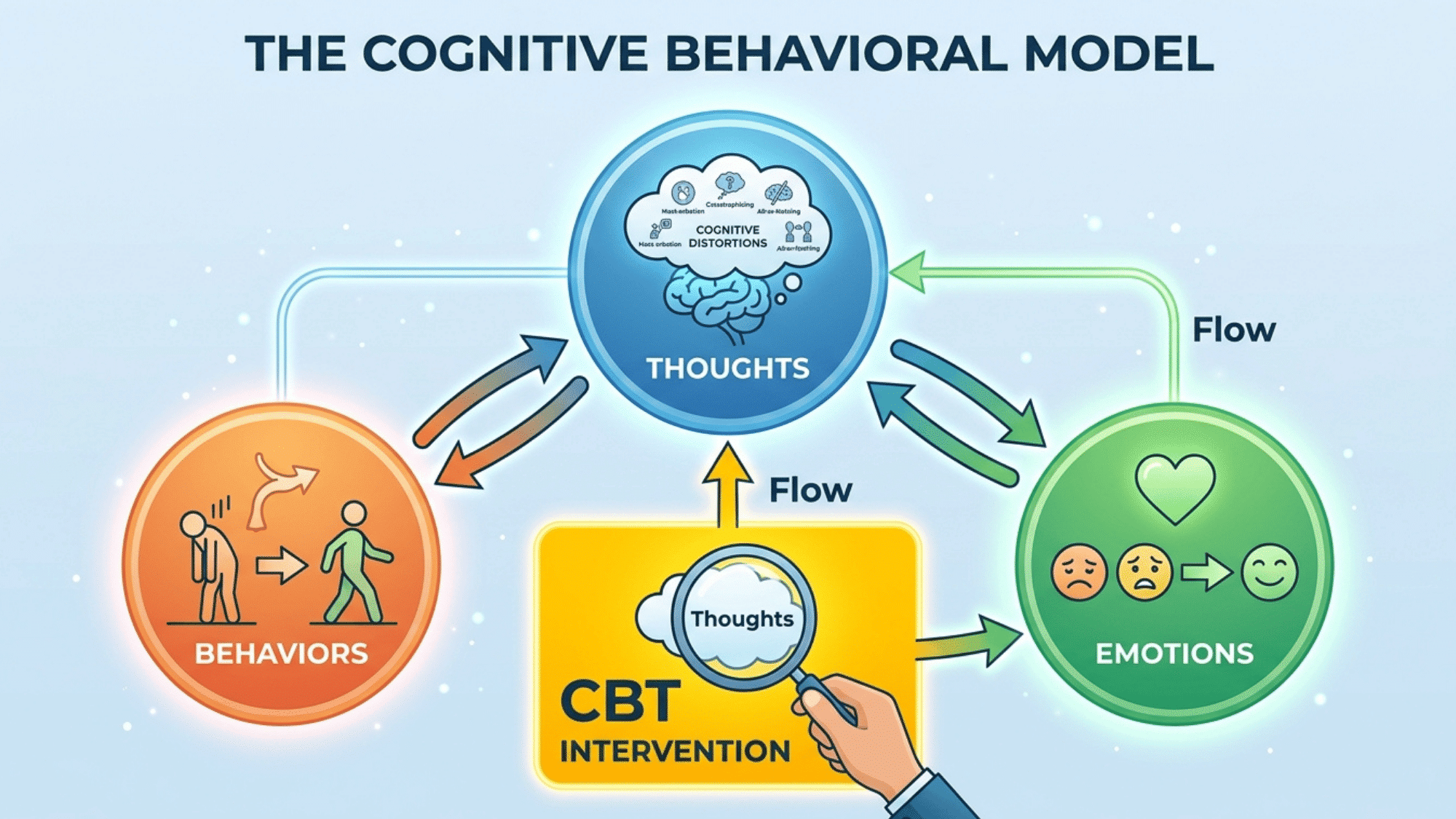
If you’re trying to understand what principle underlies cognitive-behavioral therapy? Here’s the core idea I find most helpful: our thoughts, emotions, and behaviors are closely connected.
CBT is built on the principle that unhelpful thought patterns shape how we feel and act, and that by recognizing and reshaping those patterns, we can ease distress and create real, measurable change.
In this blog, you’ll walk you through which principle underlies cognitive therapy, how cognitive disortions work, and the interventions most commonly used in CBT.
What is Cognitive Behavioral Therapy?
Cognitive-behavioral therapy (CBT) is a structured, evidence-based form of psychotherapy that helps people identify and change unhelpful patterns of thinking and behavior.
It is based on the principle that thoughts, emotions, and behaviors are interconnected, and that modifying unhelpful thinking patterns may improve emotional well-being and coping skills.
CBT is commonly used by licensed mental health professionals to support individuals experiencing conditions such as anxiety, depression, and stress-related concerns.
According to the APA and Mayo Clinic, CBT is among the most researched psychological therapies and is widely recognized for its effectiveness across a range of mental health conditions.
What Principle Underlies Cognitive Behavioral Therapy?
CBT works on the idea that changing how you interpret experiences can support healthier emotional responses and more helpful actions.
In simple terms, CBT suggests that:
- Events do not automatically determine how you feel.
- Your interpretation of events influences emotional responses.
- Thoughts can affect behaviors.
- Behaviors can reinforce thoughts and emotions.
This concept is commonly known as the Cognitive Model.
For example, two people may experience the same setback at work: one may think, “I made a mistake, but I can learn from it,” while the other may think, “I always fail.”
The event is the same, but the interpretation differs, leading to different emotional and behavioral outcomes.
Let’s understand the Cognitive Model Clearly
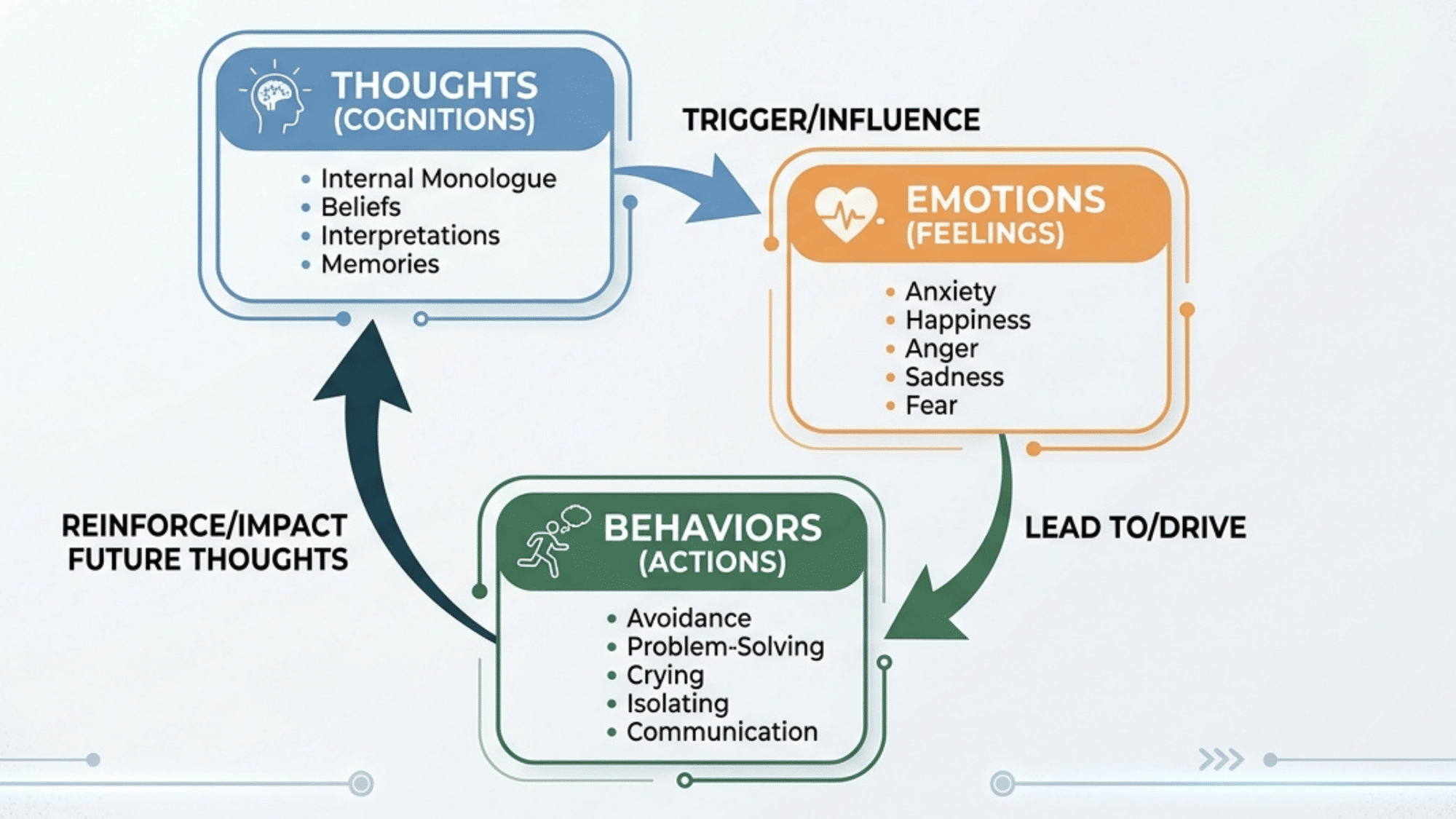
The cognitive model explains how your interpretation of events influences emotional and behavioral responses.
Rather than focusing solely on situations, it examines how beliefs, assumptions, and automatic thoughts shape reactions and decision-making in everyday life.
| Component | Description |
| Thoughts | Interpretations, beliefs, and assumptions |
| Emotions | Feelings generated by those interpretations |
| Behaviors | Actions that result from thoughts and emotions |
For example:
- Situation: A friend does not reply to a message.
- Thought: “They must be upset with me.”
- Emotion: Anxiety or sadness.
- Behavior: Avoid contacting the friend.
Over time, avoiding contact may reinforce the original belief, creating a cycle that maintains distress, and CBT interventions aim to interrupt these cycles.
Which Principle Underlies Cognitive Therapy?
Cognitive therapy is based on the principle that the way you interpret experiences influences your emotional and behavioral responses.
Rather than assuming situations alone cause distress, the approach focuses on identifying beliefs and thought patterns that may shape how events are understood.
The approach assumes that:
| Cognitive Therapy Principle | Explanation |
|---|---|
| Thoughts influence feelings | How you think affects emotional responses |
| Thoughts influence behavior | Beliefs can shape actions and decisions |
| Thoughts can be examined | Unhelpful beliefs can be evaluated objectively |
| Thinking patterns can change | More balanced thinking may support healthier coping |
Cognitive therapy is based on the principle that distorted or inaccurate thinking contributes to emotional distress and unhelpful behavior- Beck Institute
The 3 C’s Behind Positive CBT Exercises
The 3 C’s behind positive CBT exercises are simple cognitive-behavioral strategies used to help you challenge unhelpful thinking patterns and build healthier responses.
- Catch it: You identify the negative or automatic thought as it appears (for example, “I always fail”).
- Check it: You examine the thought for accuracy by considering evidence, alternatives, and cognitive distortions.
- Change it: You replace the unhelpful thought with a more balanced and realistic perspective.
What are Cognitive Distortions?
Cognitive distortions are recurring thinking patterns that can lead to inaccurate interpretations of situations.
In cognitive therapy, these patterns are examined because they may influence emotional responses, decision-making, and behavior, often reinforcing unhelpful beliefs about yourself, others, or everyday experiences.
Recognizing cognitive distortions is often one of the first CBT interventions used in therapy.
Common Cognitive Distortions
Certain thinking habits can affect how you evaluate situations, making it important to recognize patterns that may influence judgment and emotional well-being.
1. All-or-Nothing Thinking: Viewing situations in extreme categories without recognizing the middle ground.
Example: “If I am not perfect, I am a failure.”
2. Catastrophizing: Expecting the worst possible outcome.
Example: “One mistake will ruin everything.”
3. Overgeneralization: Drawing broad conclusions from a single event.
Example: “I failed once, so I will always fail.”
Why Cognitive Distortions Matter
The American Psychological Association notes that CBT helps individuals identify and modify unhelpful thinking patterns that may contribute to emotional and behavioral difficulties.
When Cognitive Distortions Become Habitual, They May:
- Increase Anxiety
- Contribute to A Depressed Mood
- Reduce Self-Confidence
- Encourage Avoidance Behaviors
- Reinforce Negative Beliefs
Key CBT Interventions Used in Practice

A major strength of CBT is its structured approach, in which therapists use evidence-based intervention strategies to help individuals understand and modify unhelpful thoughts and behavioral patterns.
1. Cognitive Restructuring
Cognitive restructuring is a core CBT intervention that involves identifying and evaluating automatic thoughts.
The Goal Is Not to Replace Thoughts with Positive Thinking but To Develop More Realistic and Balanced Interpretations.
2. Behavioral Experiments
This intervention involves testing beliefs through real-world experiences.
For Example:
- Predicting an outcome
- Gathering evidence
- Comparing Results with Expectations
3. Thought Records
Thought records provide a structured way to examine situations, emotions, and reactions, helping identify patterns that may influence decision-making.
- Identify triggering situations
- Track emotions
- Recognize cognitive distortions
- Develop alternative perspectives
4. Behavioral Activation
This approach is based on the idea that increasing participation in rewarding behaviors may help reduce avoidance patterns and support emotional well-being over time.
For example: A person experiencing low mood may schedule a short walk, complete daily tasks, or meet a friend to gradually improve mood and reduce avoidance patterns.
5. Exposure Techniques
Under professional guidance, this approach aims to reduce avoidance behaviors and build confidence by allowing opportunities to reassess perceived threats through repeated, safe experiences.
For Example: Someone with social anxiety may start by speaking briefly to a cashier, then gradually progress to attending small-group conversations in a safe, controlled manner.
| Know Your CBT in Minutes Through these Flashcards- Free Printable CBT Flashcards |
The Bottom Line
At its core, what principle underlies cognitive-behavioral therapy is simple: thoughts, feelings, and behaviors are connected, and changing one can shift the others.
The patterns are learnable, the tools are practical, and change is possible with the right support.
If this has made you curious about trying CBT, speaking with a licensed therapist is a solid next step.