
Most people feel it at some point: a quiet sense that something is missing, even when life looks fine from the outside.
It’s usually a sign that something in your life needs your attention.
If that sounds familiar, it’s very common among people nowadays. Having a sense of purpose can affect how well you sleep, how you handle hard days, and how present you feel in your own life.
This blog brings together real experiences people have shared, along with seven simple ways to find purpose in life, plus steps to help you actually put them into practice.
The two most important days in your life are the day you are born and the day you find out why. — Mark Twain
| How to Find Purpose in Life: The Quick Answer
Find purpose in life by identifying what you value most, then aligning your daily actions with it. Start small, like giving 20 minutes a day to one activity that feels meaningful, and let your sense of purpose build from consistent action rather than a single big realization. |
What is the Purpose of My Life (My Take as a Therapist)
Finding purpose in life isn’t about waking up one day with a grand mission handed to you. It’s usually smaller and quieter than that, built from moments that keep pulling your attention back.
At its core, purpose is just a reason that makes your time feel worth spending. It doesn’t have to be world-changing; it just has to feel true to you personally.
Most people feel it at some point, a quiet sense that something is missing, even when life looks fine from the outside.
Many find it by paying closer attention to their own lives rather than searching outside themselves. The rest of this post walks through why that matters and exactly how to start looking.
The Significance of Finding Purpose in Life
Purpose isn’t just a nice-to-have; it’s tied to how long and how well we live, and without it, life can feel like you’re just going through the motions, checking boxes, waiting for Friday.
Here’s what a real sense of purpose actually does for you:
- Better Sleep: Helps you sleep better and handle stress with more ease
- Heart Health: Linked to lower rates of heart disease and early death
- Daily Direction: Gives ordinary days a sense of direction instead of just repetition
- Setback Toughness: Makes setbacks feel temporary instead of permanent
- Active Decision-Making: Pulls you out of autopilot and into actual decision-making
- Built-In Toughness: Builds Toughness, since you have a reason to keep going
Ways to Find Your Purpose in Life: Detailed Breakdown
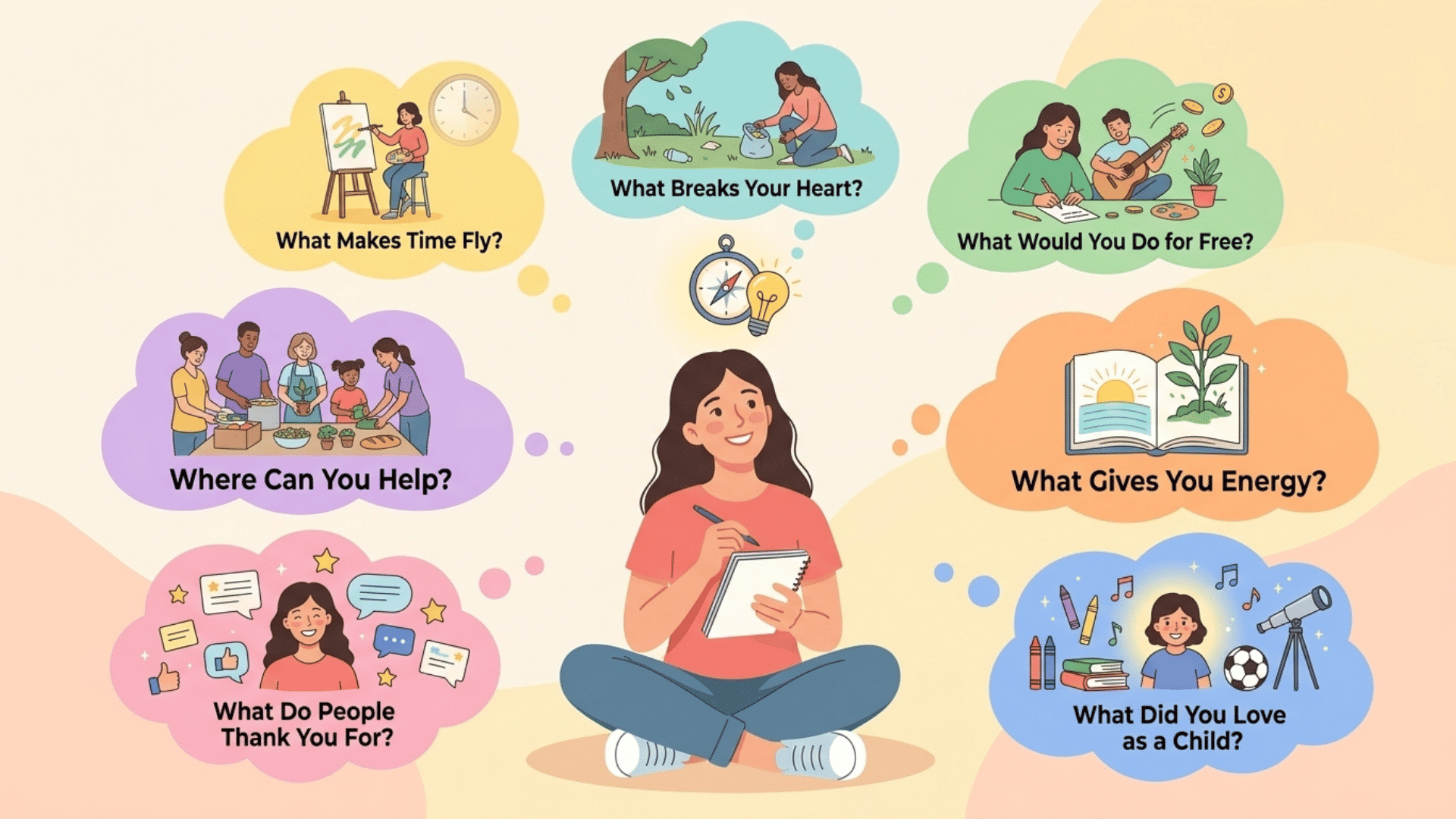
You don’t need to do all seven of these to find clarity, since trying them all at once usually backfires. Just pick one or two that genuinely pull at you, and follow through.
1. Notice What Makes You Lose Track of Time
Pay attention to the moments when hours disappear without you checking the clock. That kind of absorption is a strong clue about where your natural energy already flows.
Most people ignore this signal because it feels too simple to matter.
But purpose is rarely complicated; it’s usually just something you already do without needing to be told.
2. Pay Attention to What Makes You Angry About the World
Frustration and anger point directly at what you care about most deeply. The things that genuinely upset you are rarely random; they’re tied to your personal values.
Instead of pushing that anger away, get curious about it instead. It might be quietly pointing you toward a cause, a career shift, or a way to help.
3. Ask What You’d Do Even if Nobody Paid You for It
Money changes how we think about our time, so strip it out of the question entirely. Ask what you’d still choose to do if income were never part of the equation.
The answer often reveals what you’d protect even under pressure or in times of scarcity. That’s usually closer to your real purpose than anything tied to a paycheck.
4. Volunteer Somewhere You’ve Never Been Before
New environments force you to notice things your regular routine has made invisible. Volunteering also puts you directly in contact with real needs instead of abstract ideas.
You might discover a skill you didn’t know mattered to other people. Purpose often shows up exactly at the intersection of your ability and someone else’s need.
5. Journal Daily on What Drained You and What Filled You Up
Keeping a simple daily log removes the guesswork from self-reflection. Over a few weeks, clear patterns start to emerge about what energizes you.
You don’t need fancy prompts, just two honest lines each night.
Small, consistent data about your own life beats one big dramatic realization every time.
6. Reflect on Compliments You’ve Received Your Whole Life
Other people often notice our strengths before we do ourselves. Think back to what friends, teachers, or coworkers have repeatedly praised you for.
These recurring compliments are rarely accidental; they usually point at a real talent. That talent, used consistently, is often the seed of a much bigger purpose.
7. Revisit Childhood Interests You Dropped for “Practical” Reasons
Kids gravitate toward things before social pressure or practicality comes into play. Think back to what you loved doing before anyone told you it wasn’t a “real” path.
That early interest didn’t disappear; it just got buried under responsibility.
Revisiting it as an adult can reconnect you with a version of purpose you’d forgotten.
How to Put Purpose Into Action?
Purpose gets built through small, repeated actions, not perfect plans, and knowing your purpose means nothing if you never act on it. Here are a few strategies that actually help it stick:
|
Strategy |
How To Do It | Why It Works |
|---|---|---|
|
Commit for two weeks |
Pick one thing from the list above and commit to two weeks, not “someday” | Gives the habit enough time to feel less forced |
|
Block calendar time |
Treat it like a real appointment you can’t skip | Removes the “I’ll get to it later” excuse |
|
Tell one person |
Accountability keeps you honest when motivation dips | Makes quitting quietly much harder |
| Track your energy | Notice how you feel after each session, not just tasks completed | Energy is a clearer signal than a checklist |
|
Expect early awkwardness |
It fades once the habit settles in | Normalizing discomfort stops you from quitting too soon |
|
Revisit and adjust |
Check in every few months as you grow | Purpose shifts, so your plan should too |
Recommended read for finding purpose in life: 27 Personal Goals to Build a Better Life, which notes that “setting the right goals can bring focus, purpose, and a quiet sense of confidence to everyday life.”
Real Stories from People Who Found Their Purpose
Reading how real people stumbled onto their purpose is often more useful than any framework. Here are five genuine stories gathered from real people who answered exactly this question.
The person who found her purpose caring for foster dogs at 40.
After two decades managing restaurants, one woman only found her calling once she became a stay-at-home mom and started fostering dogs. It grew into a full doggy daycare business. It ended up healing her whole family, from her father with Alzheimer’s to her son with autism. Reddit
The person who traced her purpose back to her faith.
One woman didn’t recognize her purpose until she turned 33. She points to a strong faith that began at age nine and a lifelong habit of defending the underdog. She’d been living her purpose for years before she had words for it. Quora
The person who thought his purpose was chemical engineering.
As a high schooler in the 1980s, one man had no real direction beyond a vague plan to study engineering. His actual path became law and music production instead. His takeaway: it’s never too late to keep searching. Medium
The person who became a firefighter at 34.
Most of his classmates were in their teens or early twenties. He started firefighter training anyway, years older than most. Decades later, he says life feels far lighter than the one he left behind. Quora
The person who found his purpose after losing his finance job.
One man spent his early career as a bond trader in Chicago. Getting laid off in 2008 freed him to pick up a camera instead. That decision became Humans of New York. Cbsnews
The Bottom Line
None of the people above found their purpose by planning for it. It simply showed up once they stopped waiting and started paying attention.
That’s usually how it goes. Purpose rarely arrives through certainty first; it shows up through a conversation, a decision, or a pattern you finally stop ignoring.
Pick one thing that stood out to you today and follow it this week.
So the next time that question comes up, what is the purpose of my life, take it as a sign you’re paying attention, not a sign something’s wrong.
Frequently Asked Questions
How Do I Figure out My Life Purpose?
Start with smaller, honest questions, like what makes you feel most like yourself, since purpose usually reveals itself through small answers rather than one big realization.
What if I Don’t Know What My Purpose Is?
That’s completely normal, since most people who feel purposeless have simply been too busy meeting everyone else’s needs to stop and ask what they want.
Can Your Life Purpose Change as You Get Older?
Yes, and it’s supposed to, since the purpose that drives you in your twenties won’t necessarily be the one that drives you decades later.