
Grief doesn’t move in a straight manner. One day feels manageable, the next brings the sadness right back, and that shift alone can make you wonder if you’re grieving “wrong.”
Most people have heard of the five stages of grief, but that model has since grown into what’s now known as the 7 stages of grief.
Neither version plays out the same way twice, and knowing where you stand can bring a strange kind of relief.
Loss is hard enough without confusion about your own reaction to it. Putting a name to what you feel is often a first step worth taking toward feeling steadier.
What are the 7 Stages of Grief?The 7 stages of grief are shock, denial, anger, bargaining, depression, an upward turn, and acceptance. Each one shows up on its own schedule: you might feel foggy disbelief in week one and simmering anger three months later, long after everyone around you assumes you’ve “moved on.” There’s no fixed order, and moving back and forth between stages is normal. Some stages pass in days. Others stretch on for months. Skipping one, or landing back in it after you thought you were past it, doesn’t mean you’re doing this wrong: the framework is a way to name what’s happening inside you, not a checklist to clear in order. |
How Many Stages of Grief are There?
Different researchers have mapped grief differently over the decades. The most common versions are the five-stage and seven-stage models, though other frameworks exist too.
| Model | Stages | Known For |
|---|---|---|
|
5-Stage (Kübler-Ross, 1969) |
Denial, Anger, Bargaining, Depression, Acceptance | The original, most widely referenced model |
| 7-Stage (Expanded) | Shock, Denial, Anger, Bargaining, Depression, Upward Turn, Acceptance | Adds nuance for the early and late phases of grief |
| Dual Process Model | No fixed stages; oscillates between loss and restoration | Reflects how people move between grieving and daily life |
| Continuing Bonds Model | No fixed stages; focuses on maintaining a bond with the deceased | Challenges the idea that healing means letting go |
| Four Tasks of Mourning (Worden) | Accept the loss, process pain, adjust to a new reality, find a way to remember | Frames grief as active tasks rather than passive stages |
For a deeper look at how researchers frame the timeline and reactions involved, the National Center for PTSD has published research on how grief actually unfolds compared to the popular stage theory.
What Kinds of Loss Cause Grief?
Grief isn’t limited to death alone. Any major loss that disrupts your sense of normal life can trigger the same emotional stages, regardless of what caused it.
- Death of a Loved One: The most recognized trigger, often involving the deepest and longest emotional impact
- End of a Relationship: Divorce or a breakup can bring on the same stages, especially when it ends a shared future
- Job Loss: Losing income can also mean losing routine, purpose, and a sense of identity
- Illness or Injury: Losing independence, mobility, or long-term health can mean grieving the life you expected to have
- Major Life Changes: Moving away, retiring, or other transitions that leave you feeling unmoored can end a familiar chapter and bring a quiet sense of loss
The 7 Stages of Grief Explained
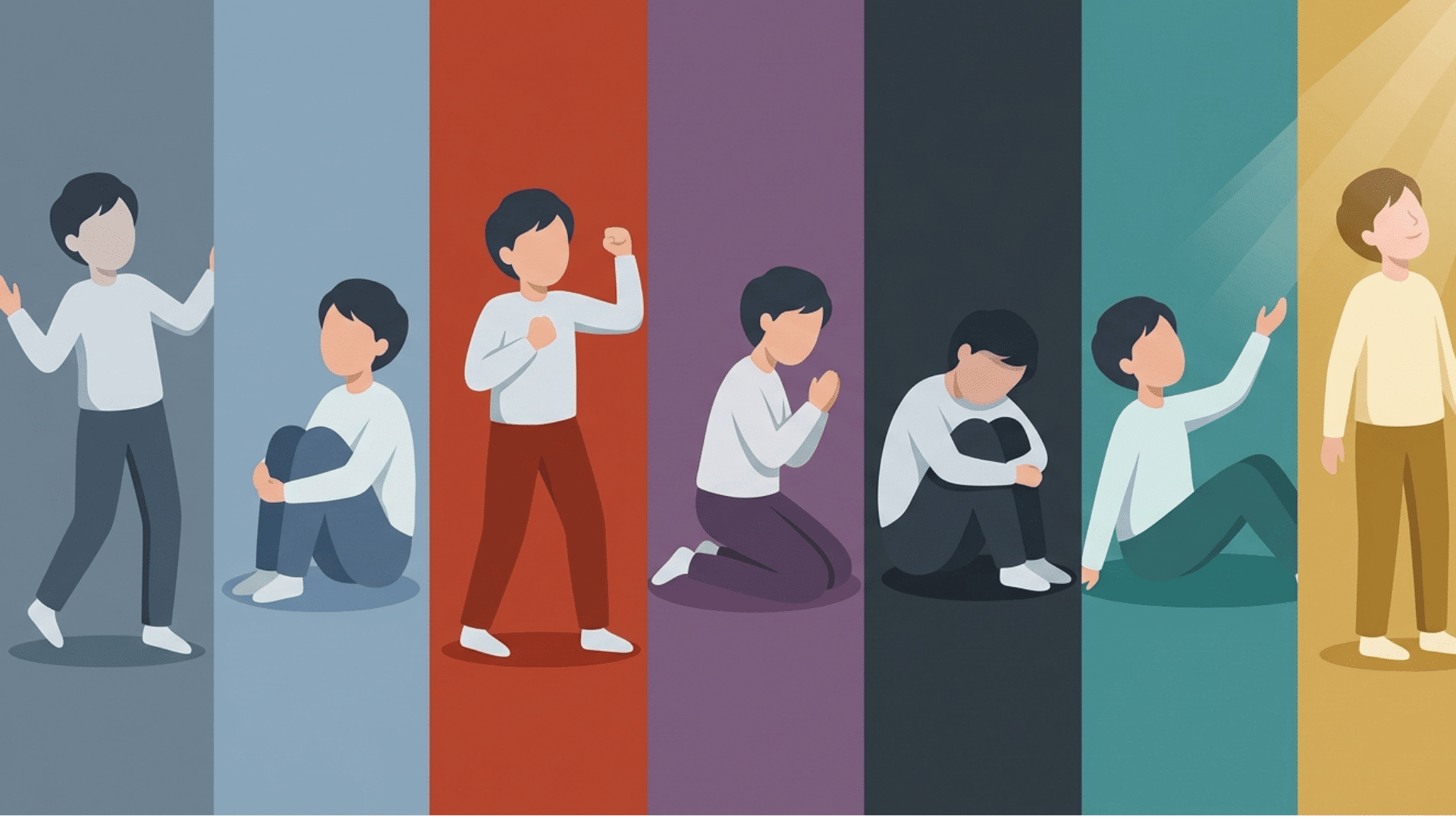
Each stage reflects a different emotional response to loss. Here’s what typically happens at each point, and why these feelings surface the way they do.
1. Shock
Shock is often the first reaction after a loss. It works as a defense mechanism, numbing the initial impact so the mind isn’t overwhelmed all at once.
You might feel detached, foggy, or unable to process what’s happened, even when the facts are clear.
This numbness usually fades within days, giving way to the emotions underneath it.
2. Denial
Denial follows shock as the mind’s way of buying time. You might catch yourself expecting a call from someone who’s gone, or going through daily routines as if nothing changed.
This isn’t a refusal to accept reality; it’s a gradual process that lets the loss sink in at a pace you can handle, rather than all at once.
3. Anger
Anger surfaces once the reality of the loss starts to register. It can be directed at yourself, at others, at the situation, or at no one in particular.
This stage often feels uncomfortable, but it’s a sign that you’re engaging with the loss rather than avoiding it, even if the emotion feels disproportionate to its target.
4. Bargaining
Bargaining involves replaying the past, searching for what could have changed the outcome. Thoughts like “what if” or “if only” are common here, often tied to guilt.
This stage reflects a need to feel some control over an event that already happened, even though nothing about the outcome can change.
5. Depression
Depression in grief brings a heavier, quieter sadness. Energy drops, motivation fades, and a hollow, disconnected feeling can make withdrawing from others feel easier than engaging.
It usually marks the point where the full weight of the loss is being felt, not avoided.
This isn't the same as clinical depression, though the two can overlap, and it's worth understanding how grief-related sadness differs from a diagnosable depressive episode.
6. Upward Turn
The upward turn is a gradual shift, not a sudden change. Daily tasks start feeling more manageable, and the constant heaviness begins to ease, even if grief still comes in waves.
It doesn’t mean the sadness is over, but the intensity that defined the earlier stages starts to loosen its grip.
7. Acceptance and Hope
Acceptance doesn’t mean the loss stops mattering. It means finding a way to live alongside it, rebuilding routines, and slowly reengaging with life.
Hope returns not as forgetting, but as room for new experiences to exist alongside the memory of what was lost.
Do Grief Stages Happen in Order?
Grief rarely moves in a clean, predictable sequence. You might feel acceptance one day and anger the next, or skip a stage entirely without ever circling back to it.
Some people move through certain emotions quickly, while others sit with one stage for months. There’s no set timeline or required path.
None of that means you’re doing it wrong. Use the stages to recognize what’s happening, not to measure your progress against a schedule.
When Grief Doesn’t Ease Up?
For some, grief doesn’t fade with time. It stays intense, disrupts daily life, and may point to complicated or prolonged grief rather than a typical stage.
- Grief Lasting Beyond a Year with No Easing: May indicate prolonged grief disorder rather than typical mourning
- Inability to Function in Daily Life: Ongoing trouble with work, relationships, or basic routines
- Persistent Intense Yearning: A constant, unrelenting longing for the person or thing lost
- Avoidance of Reminders: Actively avoiding places, people, or objects tied to the loss
- Feeling Stuck in One Stage: Being unable to move past anger, denial, or depression despite time passing
Ways to Cope With Grief at Any Stage

Coping with grief doesn’t require moving through every stage perfectly. These practical steps can help regardless of which stage you’re currently facing.
1. Allow Yourself to Feel It
Suppressing emotions tends to prolong grief rather than ease it. Let sadness, anger, or numbness surface without judging yourself for feeling them.
Naming the emotion, even privately, often makes it easier to sit with. Pushing feelings aside usually means dealing with them later, in a harder form.
2. Keep a Simple Routine
Grief can make basic tasks feel impossible. Sticking to small routines, like regular meals or a consistent sleep schedule, gives your day some structure when everything else feels unstable.
Even small, repeated habits can offer a sense of steadiness during unpredictable days.
3. Talk to Someone You Trust
Isolation tends to deepen grief over time. Share what you’re feeling with a friend, family member, or support group, even if it’s just a few honest sentences.
Saying things out loud often makes emotions feel less overwhelming than carrying them silently.
4. Seek Professional Support
If grief feels unmanageable or stretches on without easing, a grief counselor or therapist can help.
This is especially important if daily functioning is affected; knowing what to bring up in a session can make that first appointment feel less daunting.
Professional support, including dedicated grief therapy options, can also help identify whether what you’re feeling has moved into complicated grief.
Moving Toward Healing After Loss
Healing after a loss doesn’t mean forgetting or moving on completely. It means learning to carry the loss differently, where it no longer dominates every part of daily life.
The sharp pain softens over time, even if it never disappears entirely.
Small moments of joy or normalcy don’t erase the loss; they exist alongside it. Rebuilding routines, reconnecting with people, and slowly returning to activities you once enjoyed are all part of this process.
Healing isn’t a fixed endpoint but an ongoing shift, where the loss becomes something you live with rather than something that stops you.
The Bottom Line
Grief rarely fits neatly into five stages, seven, or any fixed count. What matters is recognizing your own experience as it unfolds, not matching it against a model.
The 7 stages of grief offer one way to make sense of scattered emotions, especially when everything feels confusing or out of order.
Understanding stages of grief explained this way can bring some steadiness to an otherwise unpredictable process.
If a particular stage feels stuck or unusually heavy, a grief counselor can offer support tailored to your situation. Reaching out is a practical step, not a last resort.
Frequently Asked Questions
How Long Do The Stages Of Grief Last?
There’s no fixed timeline. Some stages pass in days, others last months, and the overall process can take anywhere from several months to a few years.
Can You Skip a Stage of Grief?
Yes. Anniversaries, holidays, or a familiar song can bring back a stage you thought you’d moved past, sometimes years later. That’s a normal part of grieving, not a setback.
What is the Difference Between Grief and Depression?
Grief is tied to a specific loss and tends to ease over time. Depression is more persistent and can affect life even without a clear trigger.