
If you’ve ever felt your heart racing and the world tilting sideways, you already know how scary a panic attack can feel.
Grounding techniques can help draw your attention to what’s around you rather than the fear in your head.
In this blog, I’ll help you understand how to ground yourself with the help of grounding techniques, the symptoms of a panic attack, and which techniques may work best for you.
Disclaimer: This blog is for general information and isn’t a substitute for medical or mental health care. If panic attacks are frequent, please talk to a doctor or a licensed mental health professional. If you ever feel unsafe or in crisis, contact your local emergency number right away.
What is a Panic Attack?
A panic attack is a sudden wave of intense fear that peaks within minutes, often with no clear trigger. Your body reacts as though you’re in danger, even when nothing dangerous is happening.
Most attacks peak within about 10 minutes and ease from there, even if it feels longer. Some people have just one; others face them repeatedly as part of one of several anxiety disorders.
Symptoms of Panic Attacks:
- Physical: rapid heartbeat, chest tightness, shortness of breath, dizziness, sweating, trembling, or feeling faint (some people also notice anxiety-related nausea alongside these symptoms)
- Cognitive: racing thoughts, fear of losing control, confusion, or difficulty focusing
- Emotional: intense fear, feeling detached from reality, or a sudden sense of danger without a clear reason
- Perceptual: feeling disconnected from your body or surroundings (often described as “unreal” or “far away”)
What Do Grounding Techniques Actually Do?
Grounding uses your senses to pull your focus back to the present. During a panic attack, your mind races into worst-case thoughts, and your body reacts as if those fears are real.
Grounding breaks that loop. Instead of fighting the panic, you give your mind something concrete to hold onto, what you can see, touch, or hear right now.
It’s one of the simplest anxiety coping skills available, and it needs no equipment and can be done quietly anywhere.
NCBI Bookshelf documents grounding as a way to help someone become aware of the “here and now” during distress, rather than staying trapped in escalating panic.
Effective Grounding Techniques For Panic Attacks
Different methods work for different symptoms, so there’s no single right answer here.
The best one depends on what’s hitting you hardest in the moment, whether that’s racing thoughts, a pounding heart, or feeling detached.
1. The 5-4-3-2-1 Sensory Awareness Method
This classic technique guides you through your five senses to help you anchor yourself to your surroundings. Look around and name:
5 things you can see: a clock, a plant, a shoe, a door, a pen 4 things you can touch: the texture of your jeans, a cool desk, a coin, your hair 3 things you can hear: traffic outside, a humming fridge, and birds 2 things you can smell: coffee, soap, fresh laundry 1 thing you can taste: mint gum or toothpaste
When to choose it: Best for racing thoughts or when your mind feels too loud and scattered.
2. Temperature Interruption via Cold Exposure
When your heart is racing, a sudden change in temperature can break the panic loop. You can splash cold water on your face, hold a piece of ice, or press a cold compress to your neck.
Medical reviews note that sudden cold stimulation activates the vagus nerve, which helps regulate your heart and breathing rate.
This nudges your body back toward a “rest and digest” state instead of fight-or-flight.
When to choose it: Best for physical symptoms like a racing heart, shaking, or sweating.
3. Box Breathing
When panic makes your breathing shallow and fast, box breathing helps reset it. Picture a square with four equal sides as you follow the rhythm.
A clinical review from StatPearls (NIH) lists box breathing as a primary relaxation strategy for acute stress.
It doesn’t need a quiet room to work, which makes it useful during a sudden panic attack in public.
| Step | Action | Duration |
|---|---|---|
| Step 1 | Inhale slowly through your nose | 4 seconds |
| Step 2 | Hold the breath in | 4 seconds |
| Step 3 | Exhale completely through your mouth | 4 seconds |
| Step 4 | Hold your lungs empty | 4 seconds |
When to choose it: Best for breathlessness, a tight chest, or breathing that feels hard to control.
4. Object Focus Technique
Pick one nearby object and study it closely, its shape, texture, color, and small details. Each time your mind drifts back to anxious thoughts, gently bring it back to the object.
This pulls your awareness out of your head and into the room.
When to choose it: Best for feelings of unreality, detachment, or disconnection from your surroundings.
5. The 3-3-3 Rule
A simpler cousin of the 5-4-3-2-1 method, and easier to remember when your mind is racing.
Name three things you can see, three sounds you can hear, and then move three parts of your body: your fingers, your ankles, and your shoulders.
It takes under a minute and gives your brain a small, ordered task to follow, which is exactly what panic makes hard to do. It’s also a fast way to quiet a spiral of worried thoughts before it builds.
When to choose it: Best when you feel too overwhelmed to manage the longer 5-4-3-2-1 list.
6. Feet on the Floor (Physical Anchoring)
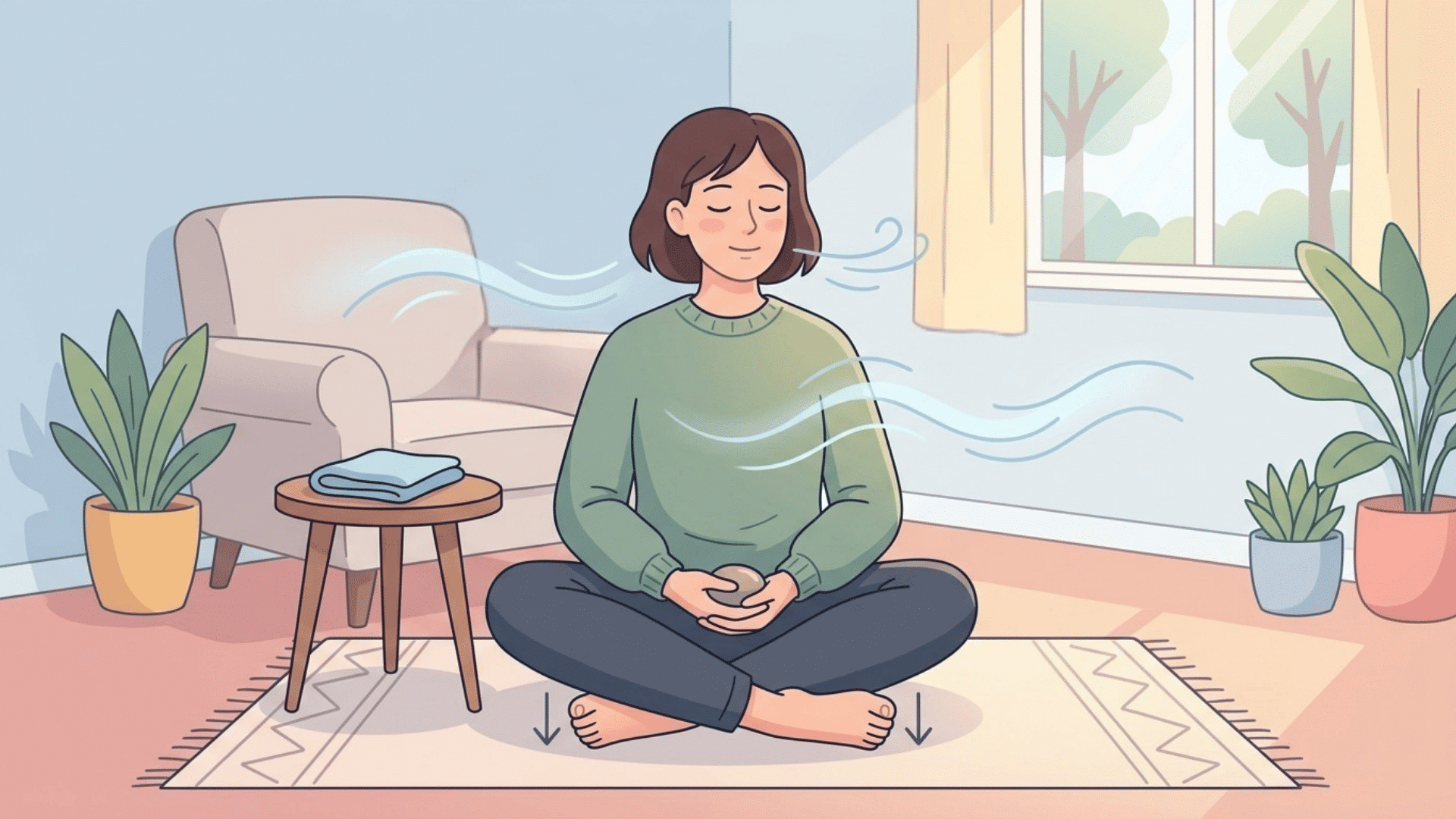
Press both feet flat into the ground and notice the contact, the pressure, the floor holding you up. You can push your feet down a little, then release.
Naming where you are out loud can help too: “I’m sitting in my kitchen. It’s Tuesday. I’m safe.” This reminds your body it’s on solid ground, not in danger.
When to choose it: Best for dizziness, feeling untethered, or when you feel like you might lose your balance.
Which Technique Should You Use?

The options above help narrow things down quickly, especially in the middle of a panic when you don’t have the headspace to weigh them.
- The simplest way is to match the method to what you’re feeling most.
- If your mind is the problem (racing thoughts, overthinking), try 5-4-3-2-1 or the 3-3-3 rule.
- If your body is the problem (pounding heart, shallow breathing), try box breathing or cold exposure.
- If you feel detached or dizzy, focusing on an object and keeping your feet on the floor tends to help most.
Common Mistakes to Avoid When Using Grounding Techniques
Grounding sounds simple, but a few habits quietly make it less effective and can leave people thinking it “doesn’t work for them” when really it just wasn’t set up right.
- Waiting Too Long to Start: Many people try grounding only once the panic has already peaked. It works best the moment you notice early signs, a tight chest, a racing pulse, rather than after the fear has taken over completely.
- Trying to Do Everything at Once: Mixing three or four techniques mid-panic (breathing, cold water, and the 5-4-3-2-1 list) can overwhelm an already overloaded mind. Pick one and stay with it.
- Expecting Instant Relief: Grounding slows and softens a panic attack; it rarely stops it cold. Treating it as a switch rather than a dimmer sets people up to feel it failed.
- Never Practicing when Calm: Trying a technique for the very first time during an actual attack is like learning to swim mid-current. It’s much harder to recall a new skill under stress than one that’s already familiar.
- Judging Yourself Mid-Attack: Thoughts like “I should be over this by now” add a second layer of distress on top of the first. Self-criticism works against grounding, not with it.
Recommended: If grounding consistently isn’t enough on its own, that’s often a sign it’s time to pair it with more structured support. Different mental health interventions exist for exactly this, and a professional can help figure out which fits.
Other Expert-Backed Proof Grounding Techniques Help
Grounding isn’t just anecdotal advice. Mental health organizations and clinicians have studied it, and here’s what they’ve found.
|
SAMHSA Clinical Experience Insight “Knowledge of grounding can help defuse an escalating situation or calm an individual who is triggered by memories or current stressors. These techniques are designed to help the person become aware of the here and now, bringing them back into contact with their immediate physical surroundings rather than remaining trapped in past trauma or escalating panic.” Source: SAMHSA |
|
NIH-Based Clinical Observation The NIH-hosted review states that grounding is “literally the perfect adjunctive support during panic attacks and heightened anxiety states.” Source: NIH |
|
Practical Behavioral Health Case Insight “Grounding techniques help shift attention away from distressing thoughts and back to the present environment. By focusing entirely on tangible sensory data such as listing nearby objects or identifying specific sounds you force the mind to stop bouncing between anxious projections and focus instead on immediate, safe physical facts.” Source: URMC |
How to Practice Grounding Before an Attack Happens?
These techniques work best when they’re already familiar, not improvised mid-panic.
Rehearse one daily, even for 60 seconds, so it becomes automatic rather than something new to figure out under stress.
Practice it in different settings, not just a quiet room, since panic doesn’t wait for convenient moments.
Pairing it with an existing daily habit, like right after brushing your teeth, gives it a natural trigger. Decide ahead of time which method fits which symptom, so you’re not choosing mid-attack.
Then track what actually helps, since it turns grounding into a reliable toolkit instead of guesswork.
When Should You See a Professional?
Grounding is a helpful tool, but it isn’t a treatment.
If panic attacks are happening often, getting in the way of work, sleep, or relationships, or making you avoid places and situations, it’s worth speaking to a doctor or therapist.
Panic disorder is very treatable, and therapy approaches like CBT, along with other options, can reduce how often attacks happen. Reaching out isn’t a last resort; it’s a practical next step.
988 Suicide & Crisis Lifeline (US): Call or text 988 for free, confidential, 24/7 support.
SAMHSA National Helpline: 1-800-662-4357 free, confidential treatment referral and information, 24/7.
Final Thoughts
Grounding won’t switch off a panic attack instantly, and it isn’t meant to. But it can take the edge off, slow the spiral, and make a frightening moment feel a little more within your control.
The real trick is to practice when you’re calm, not just when you’re panicking. That way, the steps feel automatic when an attack actually hits, and your racing mind is too scattered to think clearly.
Try a few of these methods over time and keep the ones that genuinely work for you. Everyone’s go-to is a little different; there’s no “single right” technique, only the one that helps you.
Frequently Asked Questions
Can Grounding Techniques Completely Stop a Panic Attack?
Not always. They usually lower the intensity and help the attack pass more smoothly, but they don’t switch it off like a button.
How Often Should I Practice Grounding Techniques?
A little daily practice helps when the methods feel familiar; they’re much easier to reach for during a real attack.
Are Panic Attack Grounding Techniques Medically Approved?
They’re widely recommended in clinical anxiety resources as a coping tool, though they work best alongside, not instead of, professional care when needed.