
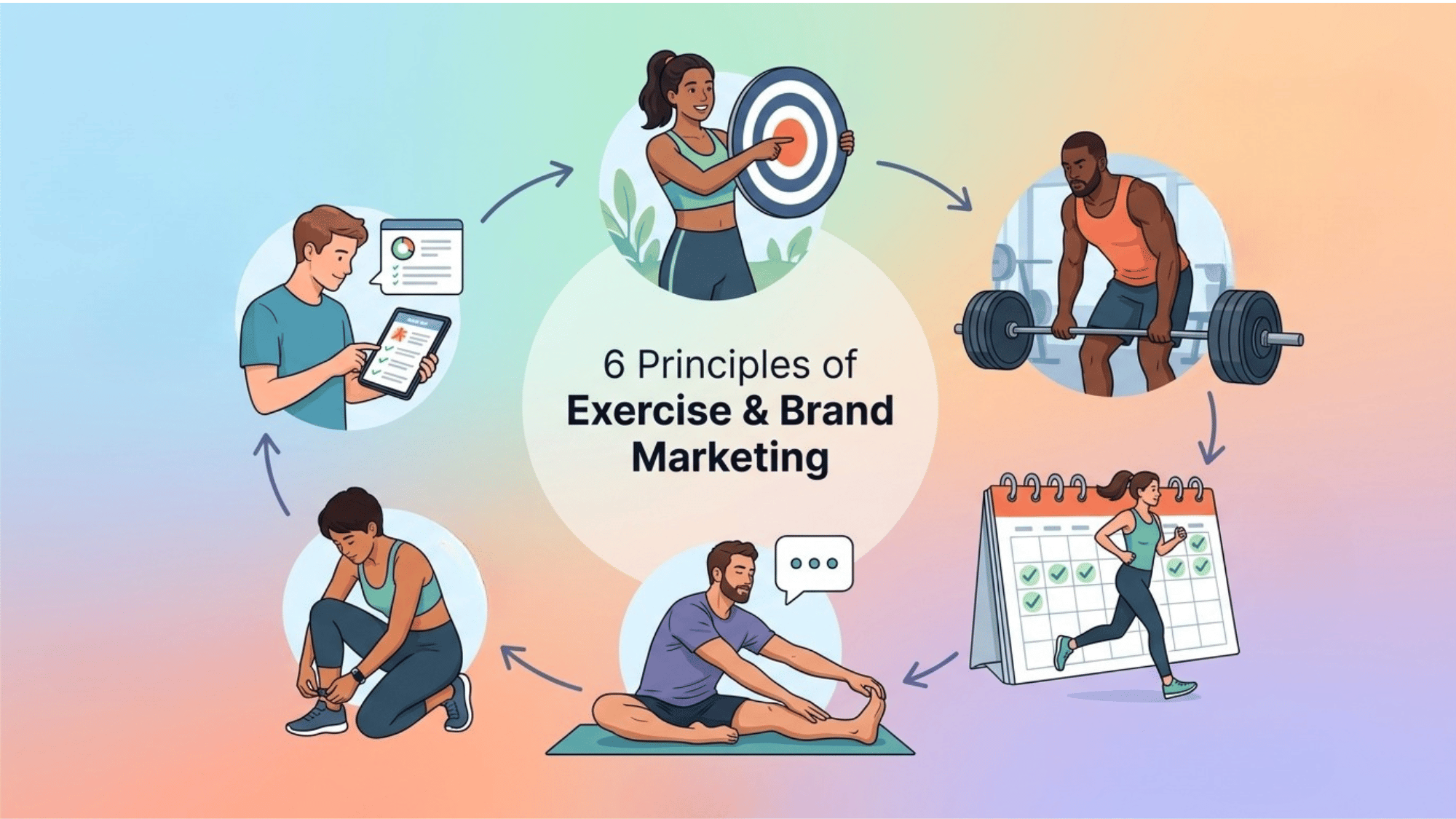
Exercise principles explain how structured physical activity produces adaptation in the human body over time.
They show why consistent effort, planned progression, and proper recovery lead to measurable improvement, while random activity often fails to create lasting results.
The principles of exercise are viewed as a structured system of adaptation built on stress, recovery, and repetition.
Interestingly, the same logic appears in brand marketing, where repeated exposure, clear targeting, and ongoing refinement shape performance over time.
“We are what we repeatedly do. Excellence, then, is not an act, but a habit.” – Will Durant
Understanding the Connection Between Exercise and Marketing
Exercise and marketing may seem unrelated, but they share a common principle: consistency drives results.
Just as regular exercise improves strength, endurance, and overall health over time, consistent marketing efforts build brand awareness, customer trust, and long-term growth.
Neither delivers instant success; both require planning, persistence, and measurable goals.
Whether it’s following a fitness routine or executing a marketing strategy, steady progress and continuous improvement are what ultimately lead to lasting results.
What are The Principles of Exercise and Brand Marketing?
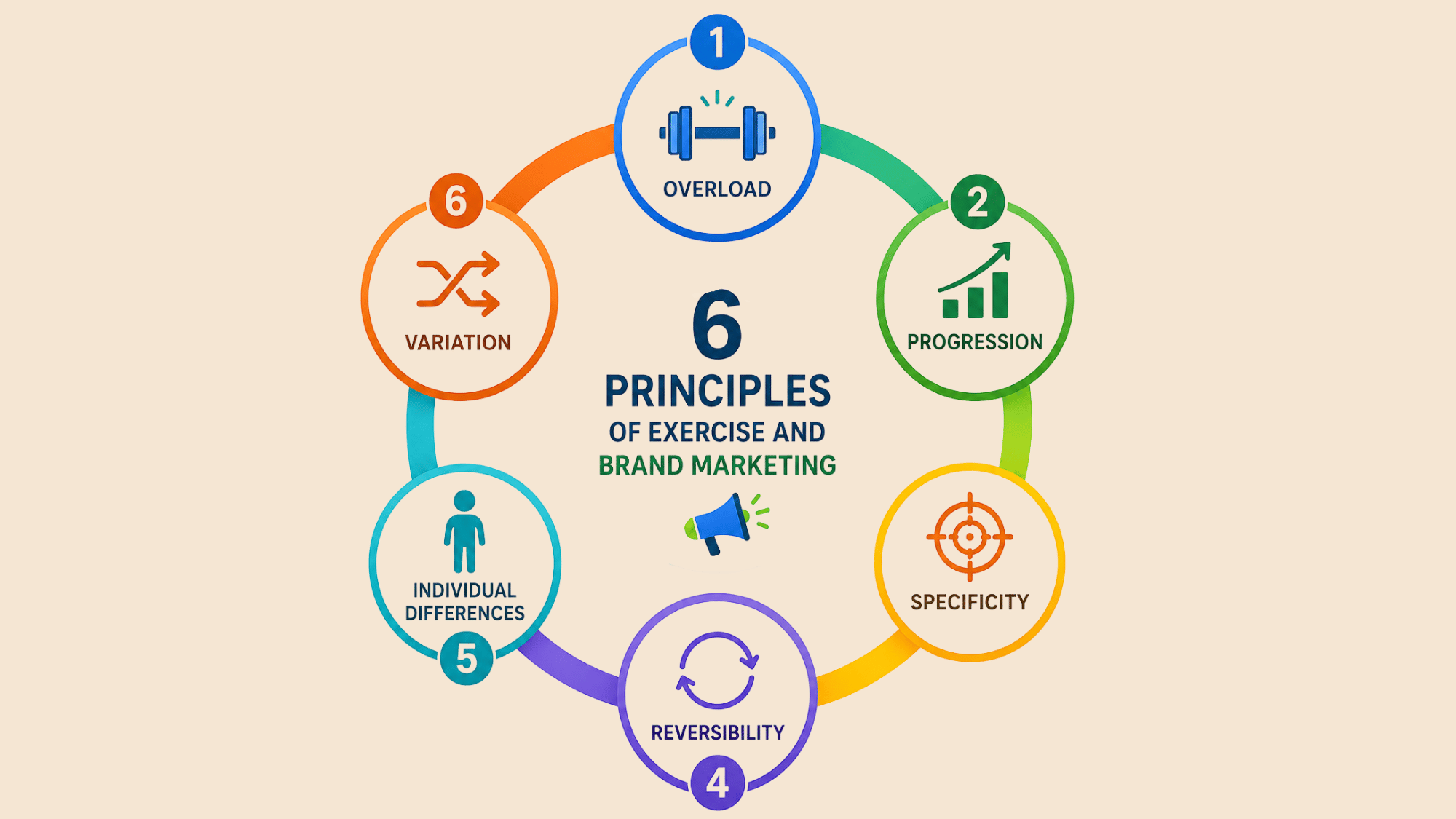
Exercise principles also mirror how structured brand marketing systems operate. Both rely on controlled pressure, gradual scaling, precision targeting, behavioral differences, consistency, and creative variation.
1. Overload: Creating Market Breakthrough Pressure
Exercise overload is one of the the principles of exercise, which refers to applying stress beyond the body’s current capacity to trigger adaptation. Without this pressure, performance remains unchanged.
In brand marketing, overload translates into increasing visibility pressure through stronger ad frequency, broader reach, or more aggressive positioning.
2. Progression: Scaling Campaigns Based on Performance Data
Progression ensures training intensity increases gradually, allowing the body to adapt safely without injury or burnout.
In marketing systems, progression reflects scaling campaigns based on performance data. Instead of increasing budgets randomly, brands expand their reach step by step using measured insights.
3. Specificity: Precision Targeting and Message Fit
Specificity states that the body adapts specifically to the type of exercise performed. Strength training builds strength; endurance training builds stamina.
In brand marketing, specificity translates directly into audience targeting and message alignment. A campaign designed for enterprise decision-makers cannot use the same messaging strategy as one targeting casual consumers.
4. Reversibility: Loss of Brand Recall without Consistency
Reversibility means that fitness gains decline when training stops. The body naturally returns toward its baseline state without continued stimulus.
In brand marketing, reversibility reflects the loss of brand recall, engagement, and market presence when campaigns are paused.
Even strong brands can lose visibility if communication stops for extended periods.
5. Individual Differences: Audience Segmentation Strategy
Every individual responds differently to the same training program due to genetics, recovery rate, lifestyle, and experience level.
In marketing, this maps directly to audience segmentation. Different groups respond differently based on demographics, behavior, intent, and purchasing power.
A single campaign rarely performs uniformly across all segments.
6. Variation: Creative Testing and Multi-Channel Strategy
Variation in exercise prevents the body from adapting too quickly to the same stimulus, reducing plateaus and maintaining continuous improvement.
In brand marketing, variation translates into creative testing, A/B experiments, and multi-channel distribution, as repeating the same message or format reduces engagement over time because audiences naturally develop content fatigue.
Brands use variation by rotating ad creatives, testing different headlines, adjusting visuals, and experimenting with platform formats.
How Exercise Principles and Marketing Systems Work Together
Exercise principles and marketing systems share a common structure: controlled input, measurable response, and continuous adaptation.
Exercise uses physiological feedback, while marketing uses behavioral data. Both rely on structured progression and repetition to create sustainable improvement.
This alignment is reflected in public health frameworks like the CDC physical activity guidelines, which emphasize consistency and structured engagement.
How Do These Principles Work in Everyday Life?
The principles of exercise are not limited to exercise science. They show up anywhere progress depends on structure, testing, and consistent improvement.
- In fitness, they guide workout programming and progression.
- In rehabilitation, they help rebuild strength, mobility, and function safely.
- In performance training, they support sport-specific improvement over time.
- Health authorities such as the CDC and HHS emphasize structured physical activity for long-term wellness.
- In both fitness and marketing, progress comes from tracking results and learning from the feedback.
- Small changes in both, according to the time, situation, and needs, are advised, as they help with adaptation.
The Key Takeaway
The six principles of exercise form a structured framework for understanding how adaptation occurs through controlled stress and recovery.
Together, they form a closed system of continuous improvement.
When extended into brand marketing, these principles reveal a shared logic between physical adaptation and audience behavior.
Both systems rely on repetition, measurement, and structured change rather than isolated effort.
Frequently Asked Questions
Why Does Brand Recall Drop when You Stop Advertising?
This is the reversibility principle in action, just as fitness gains fade without training, brand awareness and engagement decline when consistent communication stops.
How Do You Scale a Marketing Campaign without Wasting Budget?
The progression principle suggests scaling gradually based on performance data, not increasing spend randomly, but expanding reach in measured steps as results justify it.
How Long Does it Take for Brand Marketing Efforts to Show Measurable Results?
Just like fitness results don’t appear after one workout, brand marketing requires sustained effort over weeks or months before measurable improvements in recall, engagement, or conversions become visible.
Which of The 6 Exercise Principles Should a New Brand Prioritize First?
New brands should start with overload and specificity, establishing strong initial visibility pressure while ensuring messaging is precisely matched to their target audience before layering in progression and variation.