

Self-criticism often feels productive, but it rarely leads to lasting positive change. Instead, it can keep people stuck in cycles of guilt, frustration, and unrealistic expectations.
I have seen how this shift changes outcomes.
People who learn to respond to setbacks with understanding instead of harsh judgment often become stronger, more motivated, and emotionally balanced over time.
In this blog, I lay out what self-compassion means, why science links it to resilience, and the specific steps you can start using today.
What Self-Compassion Really MeansSelf-compassion is the practice of treating yourself with the same kindness you would offer a struggling friend, instead of harsh self-judgment. According to the National Center for Complementary and Integrative Health(NIH), mindfulness-based approaches like this are linked to lower stress and better emotional regulation. It is not self-esteem, indulgence, or excuse-making; it is a stable internal resource. |
The Three Core Components of Self-Compassion
Self-compassion consists of three simple practices that help you treat yourself with more patience during difficult moments.
| Core Element | Meaning | Simple Example |
|---|---|---|
| Self-Kindness | Replacing internal criticism with warmth and understanding | “I’m having a hard moment, but I can be gentle with myself.” |
| Common Humanity | Remembering that struggle, failure, and imperfection are part of being human | “I’m not the only person who struggles like this.” |
| Mindfulness | Noticing painful thoughts and feelings without suppressing or exaggerating them | “This feeling is here, but it does not define me.” |
How to Practice Self Compassion: Step-By-Step Methods
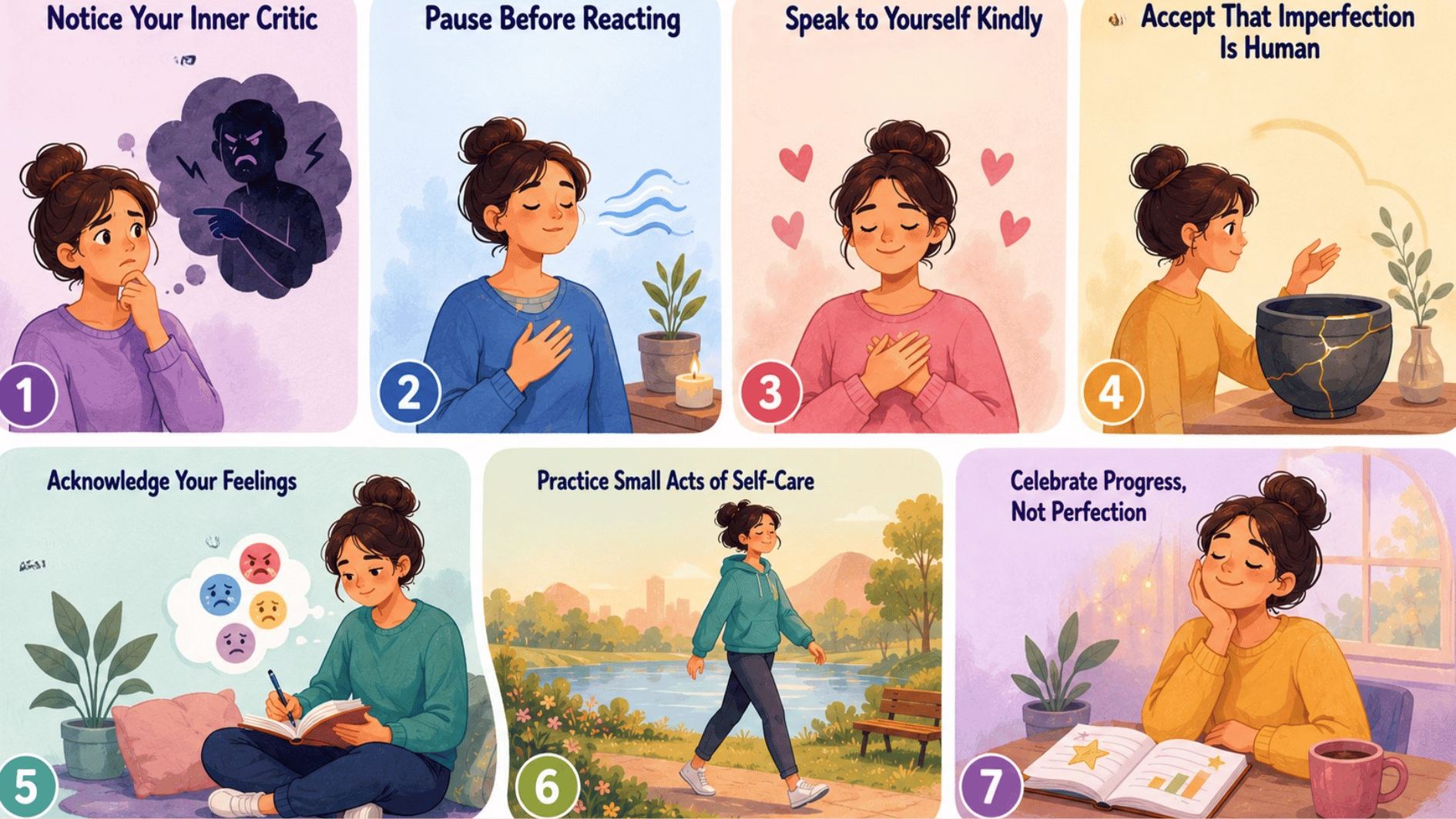
We are often our own harshest critics. Decades of research in psychology now show that the way we talk to ourselves after a setback shapes not just our mood, but our long-term resilience, motivation, and even our physical health.
1. Notice Your Inner Critic
Self-compassion starts with awareness. Before you can change a harsh inner voice, you have to catch it in the act.
Simply naming the critical voice rather than treating its verdict as fact creates the psychological distance needed to respond differently.
The tendency to offer others warmth and patience while reserving judgment and harshness for ourselves.
Learning to spot irrational, all-or-nothing thinking as it happens is often the first real turning point.
Example: After sending an email with a typo, you notice the thought “I’m so careless” and pause to label it: “That’s my inner critic, not the truth.”
| Try this: Keep a short self-compassion journal. Write down the critical thought as soon as you catch it, then write a calmer, more accurate response next to it. Left unchecked, this kind of self-talk can slide into deeper feelings of worthlessness, so catching the pattern early matters. |
2. Pause Before Reacting
When something goes wrong, the brain’s amygdala can trigger a stress response before the rational, reflective part of the brain, the prefrontal cortex, has a chance to weigh in.
Harvard Health Publishing has described how this rapid-fire alarm system can hijack our reactions, flooding the body with stress hormones and narrowing our thinking.
Deep, slow breathing activates the parasympathetic nervous system, the body’s built-in brake.
A few slow breaths before reacting to a mistake give the thinking brain time to come back online one of several practical coping skills worth having on hand for moments like this.
Example: Before replying to a critical text message, you take three slow breaths and wait sixty seconds before typing a response.
3. Speak to Yourself Kindly
Self-kindness means treating yourself with the same warmth and understanding you’d offer a friend.
This isn’t about empty positivity it’s about replacing self-punishment with the same practical support you’d offer someone you care about.
Example: Instead of thinking “I always mess this up,” you try, “This was hard, and I’m doing my best with what I know right now.”
| Try this: When you catch an absolute, punishing thought (“I always,” “I never,” “I can’t do anything right”), rewrite it as something more specific and balanced. “I missed this one deadline” instead of “I always mess this up.” |
4. Accept That Imperfection Is Human
Research in this field identifies “common humanity,” the recognition that struggle, failure, and imperfection are part of the shared human experience rather than personal defects, as a core pillar of self-compassion.
People who see their setbacks as universal rather than uniquely personal tend to recover from failure faster and ruminate less.
Example: After missing a deadline, you remind yourself, “Everyone misses deadlines sometimes — this doesn’t define my competence.”
5. Acknowledge Your Feelings
Mindfulness means holding difficult emotions in balanced awareness rather than suppressing them or being overwhelmed by them.
Research on mindfulness-based stress reduction (MBSR) has shown that regularly practicing nonjudgmental awareness of emotion is associated with measurable changes in brain regions involved in fear and stress regulation.
Avoiding or denying a difficult feeling tends to prolong it; naming it, without judgment, tends to shorten its grip.
Example: Instead of pushing away disappointment after a rejection, you say to yourself, “I feel disappointed right now, and that’s a reasonable response.”
| Try this: When steps 4 and 5 both apply at once, in a hard moment where you need to name the feeling and remember you’re not alone in it, use the self-compassion break: pause, name what feels hard, remind yourself that struggle is human, then offer yourself a kind phrase. |
6. Practice Small Acts of Self-Care
Self-care is not an indulgence; it’s maintenance.
While the APA’s stress surveys have repeatedly found that Americans who engage in basic self-care behaviors report better stress management overall.
The key word is small: self-compassion doesn’t require an overhaul of your lifestyle, just consistent, modest investments in your own well-being; even pausing to notice small things to be grateful for can count.
Example: You take a fifteen-minute walk outside after a stressful meeting instead of immediately jumping into the next task.
| Try this: Set a brief daily check-in morning or evening where you ask yourself what you need physically, emotionally, or mentally, and do one small thing about it. |
7. Celebrate Progress, Not Perfection
Perfectionism is strongly associated with self-criticism, anxiety, and burnout.
While research on self-compassion consistently finds the opposite pattern: people who acknowledge incremental progress rather than demanding flawless outcomes show greater motivation and persistence over time.
Example: After a workout that didn’t go as planned, you acknowledge, “I showed up today, and that matters more than hitting a perfect number.”
Self-Compassionate Responses for Difficult Moments
Some moments call for a quick mental reframe rather than a full exercise. Here, it contrasts common self-critical reactions with a self-compassionate alternative you can use in the moment.
| Situation | Self-Critical Response | Self-Compassionate Response |
|---|---|---|
| Making a mistake at work | “I’m incompetent.” | “This is one mistake, not my whole track record.” |
| Missing a workout | “I have no discipline.” | “I missed one session; I can return tomorrow.” |
| Conflict with a loved one | “I always ruin things.” | “This is hard, and I can still repair it.” |
| Receiving criticism | “They must think I’m a failure.” | “Feedback is information, not a verdict on my worth.” |
How Long Does it Take to See Results?
Looking for the answer to how to have self-compassion is already a sign of healing. Self-compassion is not instant, and expecting overnight change often backfires.
In my clinical observation, most people notice a measurable shift in self-talk within two to three weeks of consistent daily practice.
With bigger, more automatic changes emerging closer to eight weeks, a timeline consistent with the Mindful Self-Compassion program’s eight-week structure.
Patience with the process is itself an act of self-compassion.
The Giveaway
Self-compassion is a skill, not a personality trait, which means it strengthens with repetition.
The more often you practice it, the more natural it becomes to pause, soften your inner response, and choose a healthier next step.
I encourage you to start with just one exercise from this guide and revisit it daily for a week before adding another.
Small, consistent practice outperforms occasional intensity, and it is available to you starting with your very next difficult moment.
Frequently Asked Questions
Is Self-Compassion the Same as Low Self-Esteem or Making Excuses?
No. Self-compassion is unconditional and does not depend on comparison or achievement, whereas self-esteem often fluctuates with performance.
Can Self-Compassion Help with Anxiety and Depression?
Yes. Multiple peer-reviewed meta-analyses, including one covering 42 randomized controlled trials, link self-compassion practice to measurable, sustained reductions in anxiety, depression, and stress symptoms.
What Causes a Lack of Self-Compassion?
It often stems from childhood environments marked by harsh criticism or conditional approval, cultural messaging equating self-kindness with weakness, or perfectionism that ties self-worth to constant achievement.



One Response