Quick test: what did you do first this morning? If you reached for your phone before opening your eyes all the way, welcome to the club.
That reflex is a habit at work, and you didn’t have to think about it once.
So what is the psychology of habits? Your brain simply loves shortcuts.
Below, you’ll see how it builds them, how the cue-and-reward loop works, how long a habit takes to form, and how to change one. Yes, even the snooze button.
What is the Psychology of Habits (as Per Neuroscience)
The psychology of habits rests on two brain systems that work side by side: a goal-directed system and a habit system.
The goal-directed system picks an action based on the result you expect. The habit system triggers an action when a familiar setting shows up, regardless of the result.
|
Study insight: A 2019 review in Biological Psychiatry by Columbia psychiatrist Alana Mendelsohn tells of Sarah, a young soccer player. Passover had started days earlier, yet she grabbed a chocolate doughnut from the snack table without thinking, as she had every weekend. She hadn’t forgotten the holiday. The setting looked the same, so her habit system acted before her goals could. |
|---|
How Does Your Brain Build Habits?
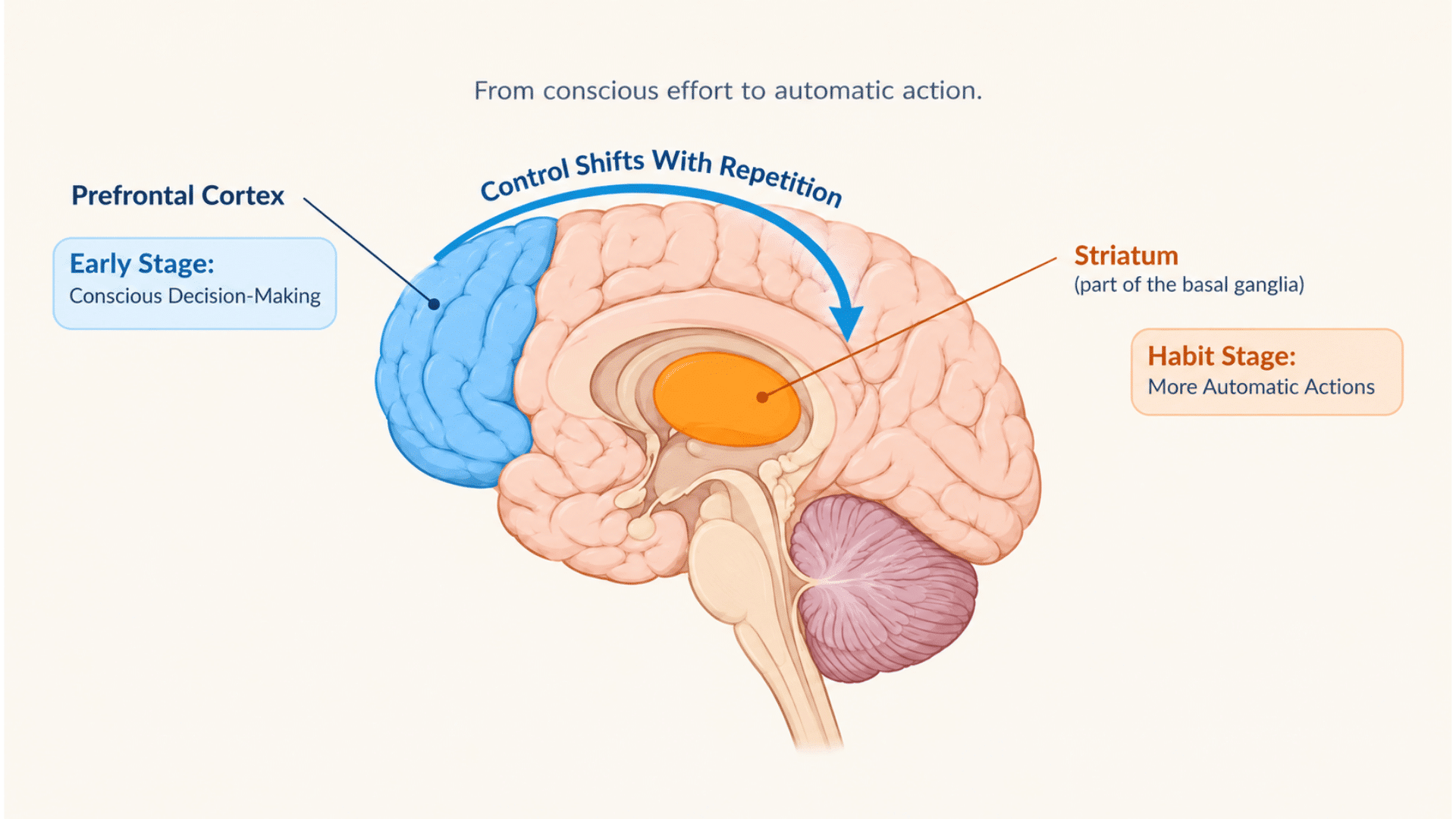
Your brain builds habits by shifting control from planning areas to areas that run on repeat. This shift saves mental effort for new problems.
The Basal Ganglia and The Striatum
The basal ganglia are a group of structures deep in the brain.
Their main input hub, the striatum, links cues with actions. Research shows its dorsomedial part guides goal-directed choices, while its dorsolateral part supports habits.
From Prefrontal Cortex to Autopilot
At first, your prefrontal cortex plans each step. With repetition, the basal ganglia take over, and the action runs with little conscious thought.
Chunking: Steps Become One Routine
The basal ganglia also bundle separate actions into a single unit. Tying your shoes feels like one move, not ten.
Dopamine’s Role
Dopamine signals when a reward is better than expected, which teaches your brain what to repeat. This helps explain why habits with quick payoffs form faster than those with delayed rewards.
Note: Calling dopamine the brain’s ‘pleasure chemical’ is misleading. It helps regulate motivation and reward-based learning, including signals about whether rewards are better or worse than expected. Also, the dorsomedial striatum is linked to goal-directed action and the dorsolateral striatum to habits
How Does the Habit Loop Work?
The habit loop rests on associative learning, which is based on 3 theories. When an action keeps paying off in the same situation, your brain links the situation with the action until one triggers the other.
-
Cue: The cue is the trigger that starts the behavior. You sit on the couch after work. Cues can be a place, a time of day, a person, a mood, or the action you just finished.
-
Routine: The routine is the behavior itself. Before you consciously decide, you pick up your phone and open an app. After enough repeats, this step needs almost no thought.
-
Reward: The reward is the payoff that teaches your brain to repeat the routine. A new message or a funny video gives you a quick break from boredom.
Note: The three-step cue-routine-reward loop was popularized by Charles Duhigg’s book The Power of Habit. It’s a helpful teaching model, but academic research focuses mostly on the link between context cues and responses, with rewards mattering most while a habit is still forming.
How Long Does it Take to Form a Habit?
You’ve probably heard it takes 21 days to form a habit.
That number traces back to Maxwell Maltz, a 1960s plastic surgeon who noticed his patients needed at least three weeks to adjust to changes, but it was never a study of habits.
A 2024 systematic review led by Ben Singh looked at habit-building studies. Only four timed how long habits took: medians ran from 59 to 66 days, averages from 106 to 154 days, and individual times ranged from 4 to 335 days.
In short, expect a new habit to start feeling automatic after about two months, with big swings from person to person.
A few factors speed things up: simple actions, staying consistent with repetition, a stable setting, and a quick reward all help.
But always remember: complex behaviors, shifting routines, and delayed payoffs slow things down.
How to Change or Break a Habit, Step by Step
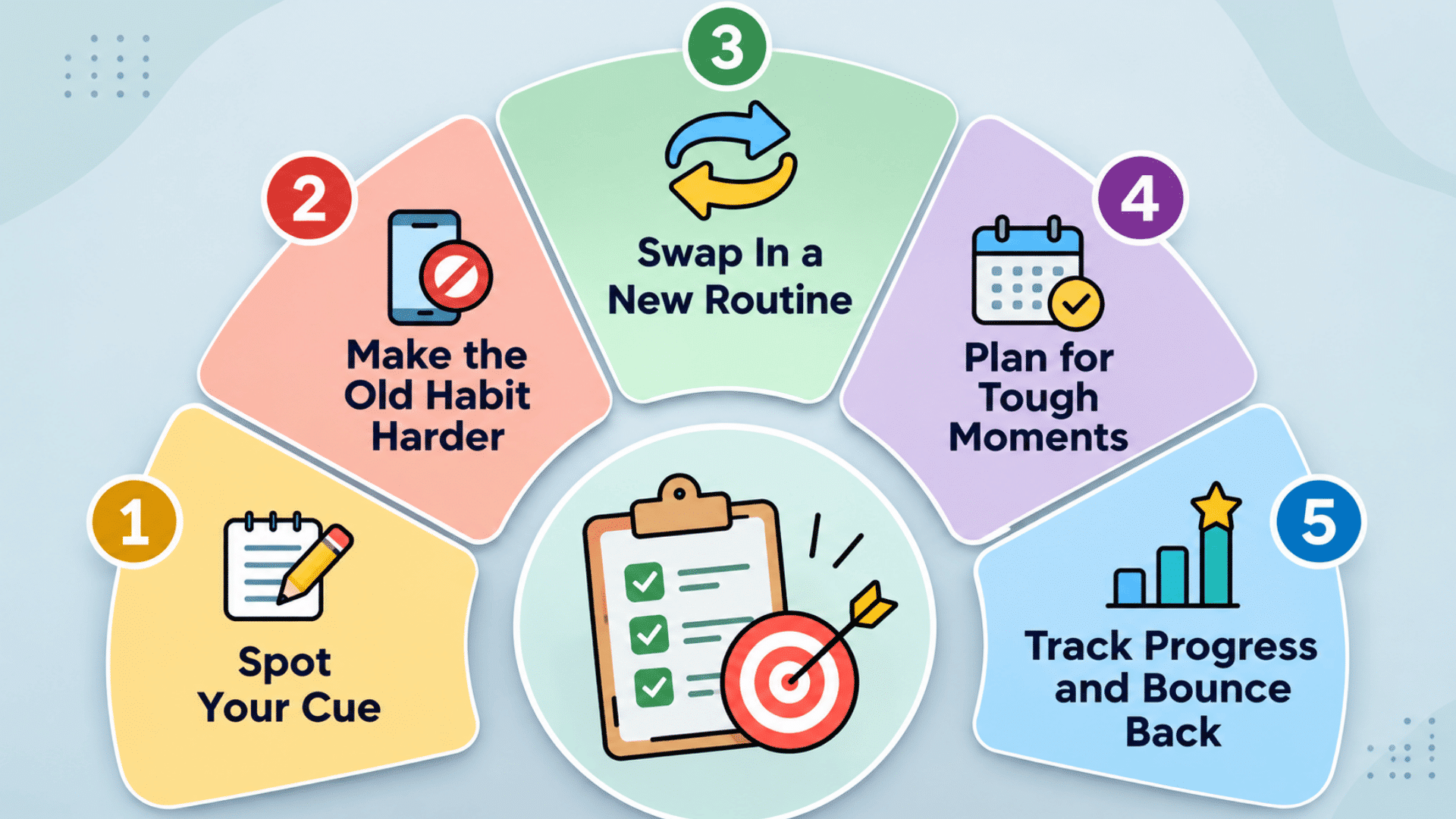
Breaking a habit works best when you change what triggers it, not just how hard you try. These five steps put the brain science from this post into practice.
Step 1: Spot Your Cue
For three to five days, jot down what happens right before the habit kicks in. Note the place, the time, how you feel, and who’s around.
Patterns show up fast, like reaching for chips only after a long work call. That moment is where you step in.
Step 2: Make the Old Habit Harder
Habits thrive on ease, so make the old one a bit of a hassle. Keep snacks in a high cupboard, log out of social apps after each use, or charge your phone outside the bedroom.
Even ten extra seconds gives your thinking brain a chance to catch up.
Step 3: Swap in a New Routine
You can’t simply delete a cue, so give it a new job instead. Keep the trigger and swap in a response with a similar payoff.
If boredom pulls you toward your phone, take a two-minute walk or stretch. The new routine needs to grow stronger than the old one.
Step 4: Plan for Tough Moments
Tired evenings and stressful days are when old habits sneak back. An if-then plan decides your move in advance. Such as “If I feel stressed at my desk, then I’ll take three deep breaths.”
Step 5: Track Progress and Bounce Back
Mark each day you stick with the new routine on a calendar or app, and enjoy the small wins. If you slip, don’t panic or be too hard on yourself, because a single missed day didn’t disrupt habit formation.
Start again tomorrow, and give the change a few months to settle in.
Examples of Healthy Vs Unhealthy Habits
Healthy and unhealthy habits often start from the same cue. The difference is the routine your brain learns to run when that cue shows up.
|
Daily Moment (Cue) |
Healthy Habit |
Unhealthy Habit |
|---|---|---|
|
Waking up in the morning |
Drinking a glass of water before coffee |
Scrolling social media in bed for 30 minutes |
|
Sitting down on the couch after work |
Taking a 10-minute walk before relaxing |
Snacking on chips while watching TV |
|
Feeling stressed at your desk |
Taking a few slow, deep breaths |
Reaching for a sugary drink or a cigarette |
|
Finishing a meal |
Clearing and washing your dishes right away |
Leaving dishes in the sink overnight |
|
Getting into bed at night |
Putting your phone on the charger across the room |
Watching videos until well past midnight |
Conclusion
Every habit you have is your brain’s way of saving effort. With enough repetition, a cue in your surroundings starts the routine for you, and the basal ganglia keep it running in the background.
That’s why old habits feel so sticky, and it’s also why you can reshape them. Instead of fighting your brain, you can work with it.
So without wasting time, start today: pick one daily moment from the table above, like sitting on the couch after work, and swap in one healthy routine for the next week.
Frequently Asked Questions
What is the 21/90 Rule for Habits?
It says 21 days builds a habit and 90 days makes it permanent. Real timelines vary much more.
What are the 3 R’s of Habits?
Reminder, routine, and reward. They’re another name for the habit loop, with “reminder” meaning the cue.
How Long Does It Take to Break a Habit?
There’s no fixed timeline. It depends on the habit, how often the cue appears, and how consistent you are.
What are the Main Types of Habits?
Psychology has no single official list of habit types. A common, informal way to sort them is physical actions, thinking patterns, and emotional responses.
Can You Replace a Bad Habit Instead of Quitting It?
Yes. Keep the same cue, then swap in a healthier routine that gives you a similar reward.