

You’ve decided to look into mental health support, and the first thing you run into is jargon.
Therapy? Counseling? One website offers therapy, another offers counseling, and both claim to help with your stress, your relationships, your 3 am spiraling thoughts.
So which one do you actually need? Turns out, the line between therapy and counseling is blurrier than most websites admit, but it’s not imaginary.
Here I will break down therapy vs counseling, where the two overlap, where they split, and how to pick the right one.
| Therapy tends to focus on longer-term emotional and mental health treatment (anxiety, depression, trauma), while counseling focuses on specific, often shorter-term problems like grief, stress, or relationship conflict; in practice, the terms are used interchangeably by most providers. |
What is Therapy and How Does It Support Mental Health?
Therapy is a form of mental health treatment that helps people understand their thoughts, emotions, and behaviors.
It involves talking with a trained mental health professional to work through challenges, develop healthier coping skills, and improve overall well-being.
People seek therapy for many reasons, including anxiety, depression, trauma, relationship difficulties, stress, or major life changes.
Therapy can be short-term or long-term, depending on your goals, condition, and the progress you make during treatment.
Signs that Suggest You Need Therapy
You may benefit from therapy if emotional or mental health challenges begin affecting your daily life, relationships, or overall well-being. These signs can indicate that professional support may be helpful.
- Persistent Emotional Distress: You feel anxious, sad, angry, or overwhelmed for weeks, and the feelings do not improve, sometimes tipping into feelings of worthlessness or hopelessness.
- Unhealthy Coping Habits: You rely on alcohol, drugs, emotional eating, or other harmful behaviors to manage difficult feelings, often fueled by challenging your irrational thoughts rather than working through them.
- Recovery From Trauma: You continue to struggle after a traumatic event, loss, or major life change that feels hard to process, and healing from childhood trauma specifically often needs a different approach.
- Symptoms Keep Returning: Your emotional or mental health concerns repeatedly come back despite trying to manage them on your own.
- Personal Growth: You want to better understand yourself, build healthier habits, and improve your overall quality of life.
What is the Purpose of Counseling in Mental Health Care?

Counseling is a type of talk therapy that helps people deal with specific problems, emotional challenges, or life changes.
It provides a structured setting where people can discuss difficult thoughts, emotions, relationships, or life events with a trained professional.
Encourages Open Expression
Counseling offers a private setting to discuss difficult feelings and experiences, including moments that call for grounding techniques for panic in the middle of a hard week. It can also help people recognize emotional triggers and repeated patterns.
Supports Difficult Experiences
People can use counseling to process grief, stress, relationship problems and patterns, illness, or major life changes. Talking through these experiences may make them feel more manageable.
Builds Practical Coping Skills
Counseling can strengthen problem-solving, communication, and emotional regulation. These skills can help people respond to pressure in healthier ways.
Improves Relationships and Daily Functioning
Counseling may help people communicate their needs and manage conflict more clearly. It can also support concentration, self-care, work, and emotional well-being.
Major Approaches to Therapy and Counseling
Therapists and counselors use different methods to help people understand emotions, manage symptoms, improve relationships, and respond to difficulties more effectively.
| Techniques | What It Involves | When It’s Used |
|---|---|---|
| Active Listening | Reflecting back what a client says, without judgment, to confirm understanding and build trust | Every approach, as a foundation |
| Cognitive Restructuring | Identifying unhelpful thoughts, then testing them against evidence | CBT, DBT |
| Exposure Therapy | Gradual, controlled exposure to a feared object or situation, reducing avoidance over repeated sessions | Phobias, OCD, PTSD |
| Mindfulness Practices | Breathing exercises, body scans, or grounding techniques that anchor a client in the present moment | DBT, ACT, anxiety-focused work |
| Role-Play | Practicing a difficult conversation or situation in session before facing it in real life | CBT, social anxiety, assertiveness training |
| Motivational Interviewing | A conversational style that helps a client explore their own reasons for change | Substance use, ambivalence about change |
| Homework Assignments | Journaling, thought records, or practice exercises between sessions | CBT, behavioral therapy |
| Genogram Mapping | A visual family tree that traces patterns like conflict, addiction, or divorce across generations | Family and systemic therapy |
The National Institute of Mental Health explains that treatment may draw from one main approach or combine several methods. The NHS also lists CBT, counseling, interpersonal therapy, DBT, EMDR, and mindfulness-based therapy among commonly used talking therapies.
Are Therapy and Counseling the Same?
In everyday use, yes, therapy and counseling are treated as the same service.
Many providers hold licenses letting them do either. Psychotherapy is just the clinical word for therapy, not a separate third category.
The overlap exists because counselors and therapists share much of the same training in listening, mental health, and talk-based methods.
One provider might run a short, focused set of sessions with one client and years of deeper work with another. Both are simply part of
| What Clinics Say: Both Cleveland Clinic and Mayo Clinic explain that psychotherapy is also commonly called counseling, talk therapy, or simply therapy. The term may change between clinics and providers even when the service is similar. |
Therapy vs Counseling Vs Psychotherapy
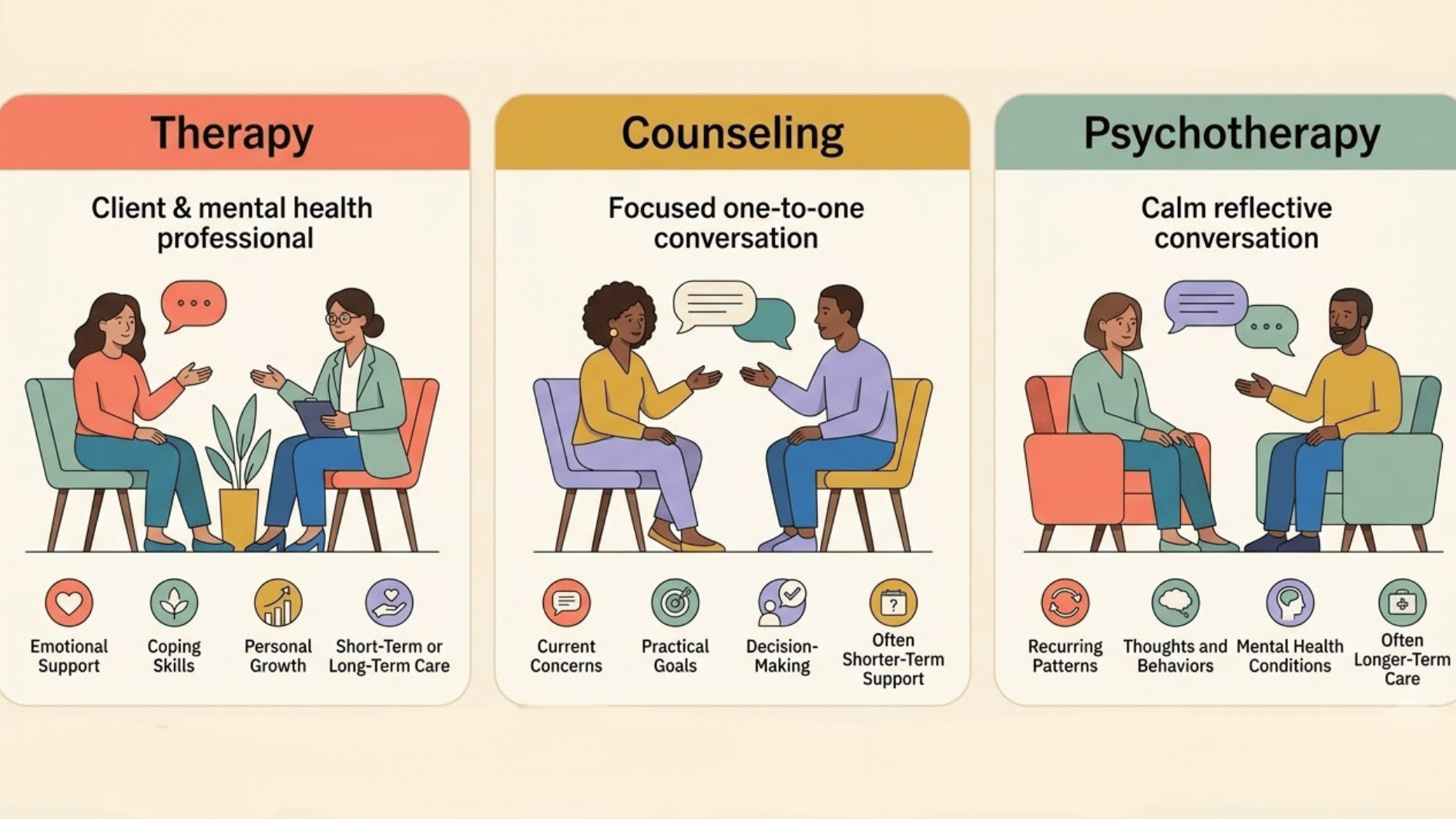
Although these terms are often used interchangeably, they can differ in focus, duration, and the types of concerns they address.
| Features | Counseling | Therapy | Psychotherapy |
|---|---|---|---|
| Primary Focus | Solving specific life challenges | Improving emotional and mental well-being | Treating deeper emotional and psychological issues |
| Best For | Stress, grief, relationship problems, career concerns | Anxiety, depression, trauma, and behavioral challenges | Complex or long-term mental health conditions |
| Duration | Usually short-term | Short-term or long-term | Often long-term, depending on the condition |
| Approach | Practical guidance and problem-solving | Talk therapy with evidence-based techniques | In-depth exploration of thoughts, emotions, and behaviors |
| Main Goal | Find solutions and build coping skills | Improve mental health and everyday functioning | Create lasting emotional and psychological change |
| Common Providers | Licensed counselors | Therapists, counselors, psychologists, or social workers | Psychologists, psychiatrists, and licensed psychotherapists |
Professionals Who Can Provide Therapy or Counseling
Several licensed mental health professionals offer therapy or counseling. The right choice depends on your needs, the provider’s training, and the type of support you’re looking for.
- Psychologists: Assess, diagnose, and treat mental health conditions using evidence-based therapy. They typically do not prescribe medication.
- Licensed Counselors: Help people manage stress, anxiety, relationship issues, grief and bereavement, and other emotional challenges through talk therapy.
- Clinical Social Workers: Provide therapy, crisis support, and practical resources while helping people cope with mental health concerns.
- Marriage and Family Therapists: Focus on relationship, marriage, and family issues, helping improve communication and resolve conflicts.
- Psychiatrists: Diagnose mental health conditions, prescribe medication, and may also provide therapy when appropriate.
Why Providers Use Different Terms for Similar Care
According to the National Institute of Mental Health, an estimated 5.0 million adolescents aged 12 to 17 in the United States had at least one major depressive episode.
In everyday practice, the words therapy and counseling often describe the same service, and the choice of term usually depends on the provider or practice rather than the care you receive.
The title a provider uses usually depends on their professional background, workplace, or personal preference rather than the type of care they provide.
For example, a Licensed Professional Counselor (LPC) may use the term counseling, while a psychologist, Licensed Clinical Social Worker (LCSW), or Marriage and Family Therapist (LMFT) may call similar services therapy.
Choosing the Right Mental Health Professional
Choose based on your needs and the provider’s qualifications, not just the service label. These simple steps can help you make the right choice.
- Identify Your Main Concern: Choose counseling for a specific issue or therapy for deeper, ongoing emotional challenges.
- Review Their Qualifications: Confirm the provider is licensed and has experience treating your specific concerns.
- Understand Costs and Coverage: Check session fees, insurance benefits, and any out-of-pocket expenses before booking, since the current cost of therapy varies more than most people expect.
- Evaluate the First Session: Notice whether you feel comfortable, understood, and confident in the provider’s approach.
- Choose the Right Specialist: See a psychiatrist for medication, a psychologist for testing, or a counselor, therapist, or social worker for talk therapy.
Does Insurance Cover Therapy and Counseling?
Yes, many health insurance plans cover therapy and counseling. Coverage varies by plan and usually depends on the provider you choose and whether they’re in your insurance network.
Some plans may require a referral from your primary care doctor, while others let you book an appointment directly. You may also need to pay a copay, deductible, or coinsurance for each session.
Before scheduling an appointment, contact your insurance provider or review your plan’s benefits to understand your coverage, out-of-pocket costs, and any referral requirements.
Conclusion
When comparing therapy vs counseling, the biggest takeaway is that the words matter less than the person providing the care.
Both can improve your mental health and coping skills. The main difference is the provider’s background, your needs, and their approach.
Instead of focusing on the label, look for a licensed professional with experience with your concerns who makes you feel comfortable, and keep in mind that mental health recovery stages rarely move in a straight line.
The right support is the one that fits your needs, whether it’s called therapy, counseling, or psychotherapy. Have you ever tried therapy or counseling? Share your experience or questions in the comments.
Frequently Asked Questions
Is What I Say in Therapy or Counseling Confidential?
Yes. What you share during therapy or counseling is generally kept private. The main exceptions are situations where there is a serious risk of harm to you or someone else.
Do I Need a Diagnosis to Start Counseling?
No. You can start counseling for everyday struggles like stress or a life change without any diagnosis, and a diagnosis is not required to be worth supporting.
Is Online Counseling as Effective as In-Person?
For many common concerns, research finds online sessions work about as well as in-person ones. Difficult or crisis situations, though, often need in-person care.