

Some children climb higher, crash harder, spin longer, and touch everything in sight.
While this may look like never-ending energy, sensory-seeking behavior is often the body’s way of seeking the input it needs.
Parents of sensory seeking kids often ask whether these behaviors are typical development or signs of a bigger sensory difference.
This guide breaks down what’s actually happening in your child’s nervous system, what the signs look like day-to-day, and when it’s worth getting a professional’s opinion.
Disclaimer: This blog is for informational and educational purposes only and is not a substitute for professional medical advice, diagnosis, or treatment. It does not replace a formal sensory or developmental evaluation.
What is Sensory Seeking Behavior?Sensory-seeking behavior is when a person’s brain constantly craves more sensory input, such as touch, movement, sound, or pressure, than usual, leading them to repeatedly seek out strong physical sensations to feel calm, comfortable, and focused. Occupational therapists have studied this since Dr. A. Jean Ayres developed Sensory Integration theory in the 1970s: some children simply have higher sensory thresholds, meaning they need more intense experiences to feel regulated and engaged with their environment. Genetics, brain connectivity, and preterm birth are among the factors being studied. Sensory seeking behavior can appear on its own or alongside autism, ADHD, or other sensory processing differences. |
The Science Behind Sensory Seeking Behavior
To understand why some children seek out constant movement or pressure, it helps to look at how the brain processes sensory input in the first place.
- The brain constantly processes signals from the body and environment, and in some children, this system needs stronger input to register as “enough”
- The proprioceptive system, which uses receptors in the muscles and joints, helps the brain understand where the body is in space and how much force it’s using
- When this input feels insufficient, the brain sends out a kind of “craving” for more, pushing the child toward jumping, crashing, pushing, or climbing
- Deep-pressure activities, like hugs or weighted input, activate this same system and often help a child feel more grounded and regulated
- Sensory processing differences can affect how a child learns, focuses, and manages emotions throughout the day
- In simple terms, the behavior isn’t random restlessness; it’s the body’s attempt to self-regulate by seeking the sensory “dose” it needs
- Viewing the behavior this way shifts the focus from correcting the child to understanding and meeting the need underneath it
In my clinical reading, the most useful idea is simple: the behavior is a solution the child has found, not a problem they are causing.
Signs and Characteristics of Sensory Seeking Behavior

Sensory seeking shows up across several senses, and most kids display a personal mix rather than one fixed pattern.
1. Movement and Body Awareness Signs
These children rarely sit still.
A child may seek strong movement to wake up an under-responsive system. They might be in constant motion, such as spinning, jumping, or rocking.
The child might also have a problem respecting others’ personal space, standing too close to them, or being clingy.
Example: A child can’t sit still at the dinner table, constantly slides off the chair, swings legs, or gets up and spins around between bites
2. Touch and Tactile Signs
Tactile seekers want to feel everything. Common signs include touching every surface, enjoying messy play, mouthing or chewing on objects like sleeves and pencils, and pressing hard while writing or coloring.
They may also seek deep-pressure hugs.
Example: Child presses so hard with a pencil that it tears the paper, and loves squishing food with bare hands instead of using cutlery
3. Sound and Oral Signs
Some children chase auditory input. They make loud noises simply to hear them, enjoy noisy environments others find overwhelming, turn up the volume, or repeat sounds.
Oral seekers often chew, suck, or crunch on textured foods and non-food items to feel regulated.
Example: Child chews on pen caps, sleeves, or collars while thinking, and always wants the TV or music turned up louder than everyone else finds comfortable
4. High Pain Threshold
Because their nervous system under-registers input, many sensory seekers show a reduced reaction to pain or temperature.
They may not notice bumps and scrapes, which can lead to unintentional injury, so adults should watch for unreported hurts.
Example: Falls and scrapes their knee while playing, but get straight back up without crying or mentioning it — the injury is only noticed later by a parent
Ways Sensory Seeking Affects Daily Life
In my experience reviewing occupational therapy resources, many sensory seeking kids are not intentionally disruptive, and they are often trying to meet a sensory need that others may not immediately recognize.
- Safety Risks: A child may unknowingly engage in dangerous acts, such as jumping from heights
- Learning: Constant movement can interrupt focus in the classroom
- Social Life: Standing too close or rough play can strain friendships
- Family Routines: Mealtimes, dressing, and sleep may become harder to manage
The Link Between Sensory Seeking and Autism
Sensory differences are a core, formally recognized feature of autism, which is why the link between sensory seeking and autism deserves attention.
In 2013, sensory differences were added to the diagnostic criteria for autism spectrum disorder in the DSM-5. The DSM-5 recognizes three sensory patterns: hyperresponsive, hyporesponsive, and sensory seeking.
A 2019 meta-analysis in the Journal of Autism and Developmental Disorders (Ben-Sasson et al.) reviewing data on sensory symptoms confirmed that seeking behavior appears significantly more often in autistic children than in their typically developing peers.
However, it is important to clarify that a sensory-seeking child is not automatically autistic. ADHD and sensory processing differences can also produce similar behaviors.
In autistic children, sensory seeking often looks like repetitive motion for its own sake, rocking, spinning, or hand-flapping, paired with visible enjoyment rather than an obvious “reason.” In autistic adults, the same craving is more often put into words: a need for pressure, texture, or sound to feel regulated.
Practical Strategies to Support a Sensory Seeking Child
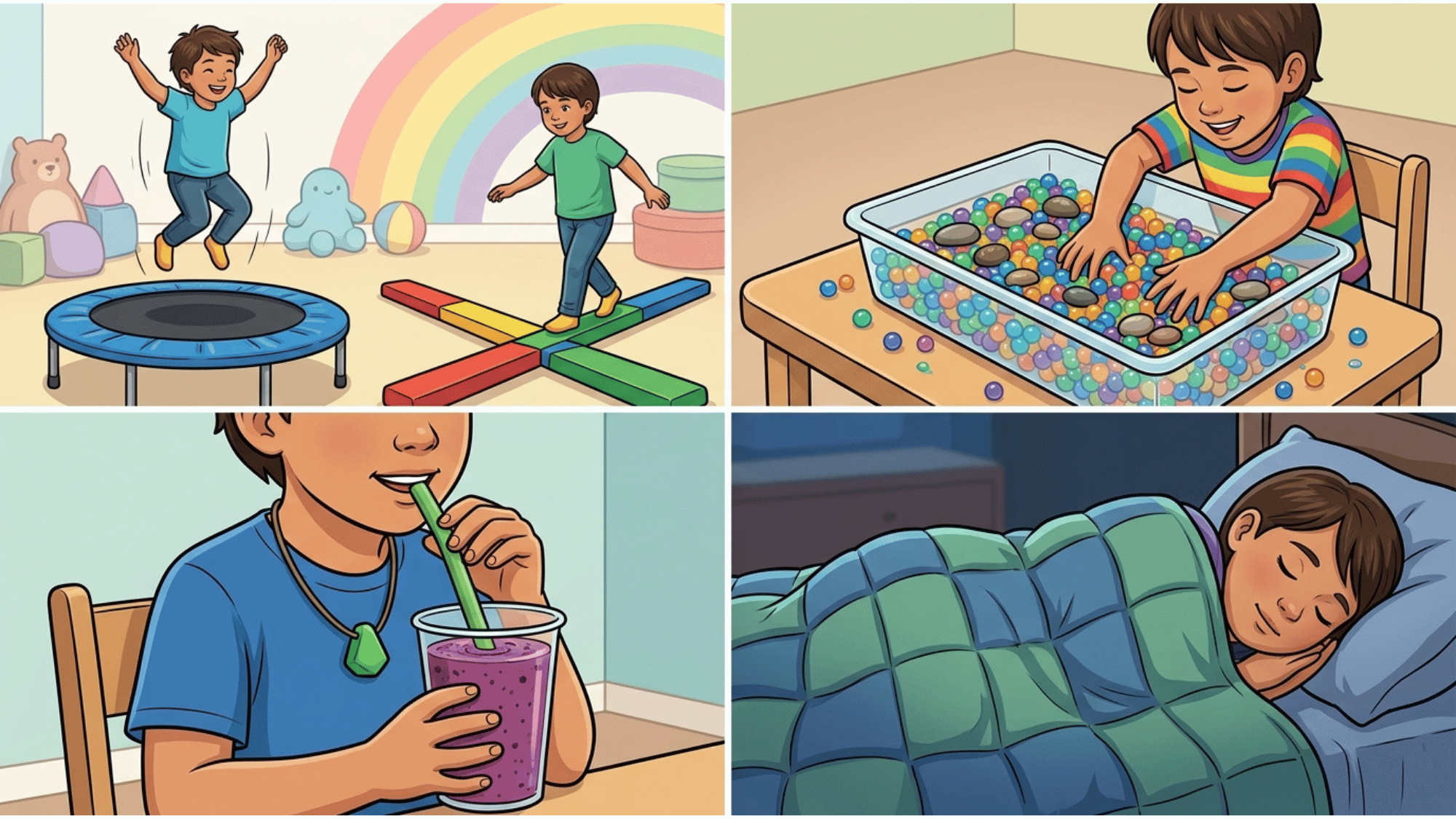
These strategies focus on giving the body the input it craves in safe, structured ways. Introduce them gradually and watch how your child responds, since what calms one child may overstimulate another.
| Strategy | Description |
|---|---|
| Heavy Work | Uses pushing, pulling, carrying, or climbing for deep body input |
| Short Breaks | Brief movement breaks help reset focus |
| Weighted Blanket/Lap Pad | Provides calming, deep pressure |
| Sensory Diet | Personalized routine based on your child’s needs |
| Chores as Therapy | Laundry, vacuuming, or wiping adds helpful resistance |
| Calm Zone | Quiet space for sensory reset |
| Resistance Play | Bands on chair legs allow seated movement |
Real Experiences From Families and Individuals
The examples here are drawn from personal stories shared in online communities and show how sensory seeking shows up in real life, from toddlers to autistic adults describing their own needs.
An Autistic Adult Describes What Sensory Seeking Feels Like
A member of the r/autism community explained that sensory seeking is, at its core, looking for input that feels good. They described rubbing fabric against their face and hands, and noted that hand flapping, pacing, swinging, biting, and squeezing things can all be forms of seeking that look different from person to person.
A Parent Spotting Vestibular Seeking in a Toddler
A parent in the r/ScienceBasedParenting community shared that their 26-month-old, in early intervention for a speech delay, calmed down when turned upside down. A provider suggested he was seeking vestibular input. As a baby, he could only fall asleep when bounced firmly.
A Parent Coping With Constant Movement
A parent in the r/toddlers community described their 2.5-year-old’s nonstop need to move, climb, and touch everything. They wrote honestly about the exhaustion of managing this alongside a newborn, and the relief of hearing from other families, a reminder of how draining unmet sensory needs can be for caregivers.
An Autistic Adult on Seeking and Avoiding at Once
A member of the r/AutismInWomen community shared that she loves blasting loud music and craves spicy, heavily seasoned food, even though everyday noise bothers her. This shows how a person can seek some kinds of input while avoiding others at the same time.
When to Seek Professional Help?
Most sensory seeking is manageable at home, but a few signs mean it’s time to bring in outside help.
- Sensory seeking interferes with your child’s safety, learning, or relationships.
- Your child often takes physical risks, crashes too hard, or gets hurt without noticing.
- The behavior becomes self-injurious, aggressive, or difficult to redirect.
- Daily routines like dressing, eating, sleeping, or schoolwork become consistently difficult.
- You suspect autism, ADHD, or another developmental condition may be involved.
If the behavior does not improve or begins to affect daily life, consider connecting with a specialist or a support organization, such as Autism Speaks, for guidance, resources, and next steps.
Final Thoughts
Sensory seeking behavior is your child’s way of meeting a real neurological need, not misbehavior. Once you understand what input they crave, you can replace risky habits with safe, satisfying activities.
With observation, structure, and professional guidance when needed, sensory-seeking kids can grow at home, in school, and with friends; the first step is simply learning to read what their bodies are asking for.
Small, consistent changes can make daily life feel safer, calmer, and more manageable for everyone.
Frequently Asked Questions
Is Sensory Seeking Always a Sign of Autism?
No, sensory seeking can occur on its own or alongside ADHD and sensory processing differences, so it is not automatic proof of autism.
What are the 5 Sensory Disabilities?
Visual Impairment / Blindness, Hearing Impairment / Deafness, Somatosensory / Tactile Impairments, Deafblindness, and Sensory Processing Disorder are the five sensory disabilities.
Do Kids Grow Out of Sensory Seeking Behavior?
Some children see these behaviors ease with age and better coping skills, while others continue to need sensory support, so outcomes vary by individual.